

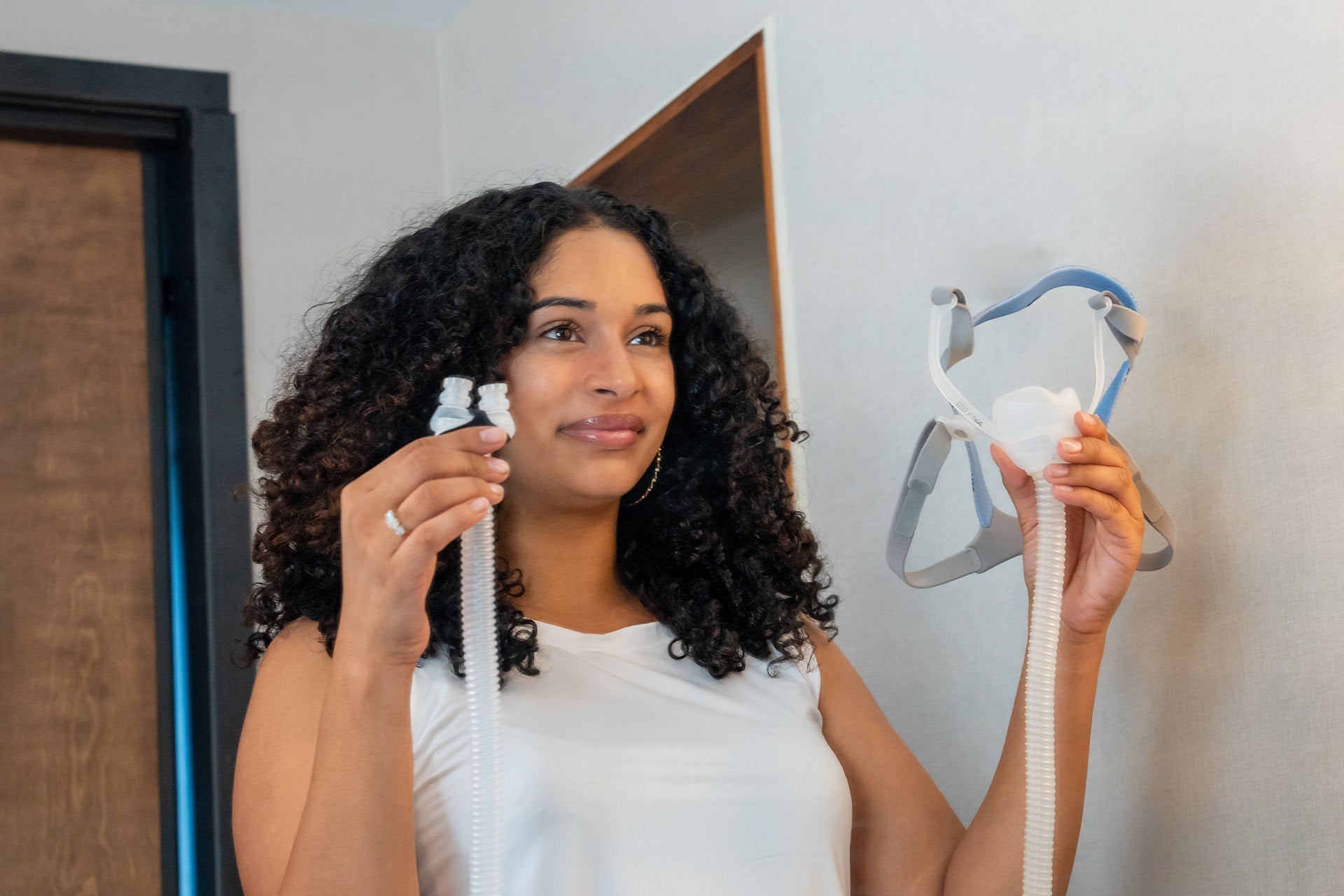
If you have been struggling with your CPAP mask, you are not alone. The straps slip overnight, the cushion leaks by 3 AM, and waking up with strap marks across your face is basically a given. For a lot of people, the issue isn't CPAP therapy itself; it's the mask design.
Adhesive CPAP masks work completely differently from traditional options. Instead of a frame and headgear that wraps around your head, they use a direct-contact seal at the nostrils. No straps. No foam cushion pressing into your face. Just a lightweight interface that stays put without any of the hardware.
So which one is actually right for you? That depends on how you sleep, what's been frustrating you, and what your therapy requires. Here's an honest breakdown of both.
What Is a Traditional CPAP Mask?
Traditional CPAP masks fall into three main types. Understanding what each one does helps you see where the friction usually comes from.
Full Face Masks
These cover your nose and mouth and are held in place with a multi-point headgear system. They work well for mouth breathers and patients on higher pressure settings, but they are the bulkiest option. Side sleepers often find them difficult to tolerate because the frame digs into the pillow.
Nasal Masks
Nasal masks sit over the nose only, with a softer seal around the bridge and sides. They are smaller than full face masks but still rely on headgear to maintain pressure against your face. Fit is critical, even a slightly off-sized cushion causes leaks.
Nasal Pillow Masks
Nasal pillows are the smallest traditional option. Two small inserts fit just at the nostril openings, held in place by a light headgear frame. They suit active sleepers and those who feel claustrophobic in larger masks, but higher pressures can cause discomfort at the nozzle contact points.
All three designs share one thing: they depend on tension from straps to maintain the seal. Adjust too loose and you leak. Adjust too tight and you wake up with indentations, soreness, or skin breakdown.
What Is an Adhesive CPAP Mask?
An adhesive CPAP mask replaces the headgear-and-cushion system entirely. Instead of wrapping around your head, it uses a medical-grade adhesive interface that attaches directly to the skin around your nostrils.
There are no straps. No headgear. No frame sitting over your face.
The seal is created by the adhesive contact itself, which means it stays consistent regardless of your sleep position. You can roll from your back to your side to your stomach without the mask shifting, leaking, or needing to be readjusted.
BleepSleep's Eclipse™ is one of the clearest examples of how this design has evolved. It uses a magnetic MagSeal™ system with disposable adhesive Halos that attach directly at the nostrils. The magnetic connection makes putting it on and taking it off during the night simple, while the adhesive maintains the seal at the skin level.
Because the contact point is much smaller and there's no mask sitting over your face, many users find they can sleep in positions that were impossible with traditional headgear, face down, pressed into a pillow, or on their side without the mask twisting.
Side-by-Side Comparison
Here's where the two approaches differ most significantly:
Seal mechanism: Traditional masks rely on foam or silicone cushions held against the face by strap tension. Adhesive masks create the seal at the skin level using medical-grade adhesive. Once the adhesive sets, the seal holds independently of body position.
Sleep position flexibility: With a traditional mask, side and stomach sleeping can be limited because the frame contacts the pillow and shifts the cushion out of position. Adhesive masks have a much lower profile, which makes them significantly more compatible with non-back sleeping positions.
Skin and comfort impact: Straps create pressure points across the bridge of the nose, cheeks, and the back of the head. Over time, this leads to skin irritation, strap marks, and for some people, sores. Adhesive masks eliminate strap pressure entirely. The trade-off is that some people experience skin sensitivity to the adhesive, so testing tolerance matters.
Set up and daily use: Traditional masks have multiple components to wash and reassemble. Adhesive systems typically involve replacing the adhesive interface (such as Halos) on a regular schedule, which is simpler but does create a recurring supply cost.
Pressure range compatibility: Traditional full face masks handle the widest range of pressure settings, including high-pressure therapy and BiPAP. Adhesive nasal designs are generally best suited for low to moderate pressure settings, and they require nasal breathing. If you breathe through your mouth during sleep, an adhesive nasal mask alone won't work.
Who Does Best With an Adhesive CPAP Mask?
Adhesive CPAP masks are not for everyone, but for certain sleepers, they make a genuine difference in whether therapy actually sticks.
You will likely get the most out of an adhesive design if:
-
You are a side or stomach sleeper who battles leaks from the mask shifting overnight
-
You have tried multiple traditional masks and still wake up with strap marks or skin irritation
-
You feel claustrophobic wearing a mask frame over your face
-
You have low to moderate pressure settings and breathe through your nose
-
You travel frequently and want a simpler, lighter carry
If you are curious about how CPAP therapy can become easier to stick with overall, the guide to making CPAP easier to use covers several practical adjustments beyond mask style.
Who Should Stick With a Traditional Mask?
Traditional masks remain the right choice in specific situations:
-
You require high-pressure settings or BiPAP therapy, where a full face mask provides more stability
-
You breathe through your mouth during sleep (nasal-only designs won't seal properly)
-
You have skin sensitivity or conditions that make adhesive contact on facial skin a concern
-
You need a mask that a sleep clinic can fit and monitor in a standard way
None of this means traditional masks are better, it means they match a different set of clinical needs. The best mask is the one you actually wear consistently, every night.
According to a study published in the journal CHEST, CPAP adherence rates among sleep apnea patients typically average between 30% and 60% in clinical populations. Mask discomfort is consistently cited as one of the primary reasons people abandon therapy. Getting the fit and design right isn't a comfort preference, it has direct consequences for how well your treatment works. Poor sleep quality and untreated sleep apnea have real health consequences; you can learn more about how sleep apnea affects heart health and why consistent therapy matters.
Making the Switch: What to Expect
Switching from a traditional mask to an adhesive CPAP mask is a short adjustment period for most people. The first few nights involve getting used to the placement, making sure the adhesive has proper contact, and confirming the seal holds at your specific pressure setting.
A few practical notes if you are considering the switch:
Skin prep matters: Clean, dry skin without residual moisturizer gives the adhesive the best contact surface. Oils and lotions break down adhesive bonds quickly.
Facial hair affects seal quality: Full beards or heavy stubble near the nostrils will reduce adhesive contact. Light stubble is generally manageable, but dense growth requires testing.
Start with your back: Even if you are a side sleeper, spend the first night or two on your back to confirm the seal is solid before testing other positions.
Follow the replacement schedule: Adhesive interfaces have a set wear life. Reusing them past their intended lifespan reduces seal quality and increases leaks.
Frequently Asked Questions
Are adhesive CPAP masks covered by insurance?
Coverage varies by plan and provider. Many insurance policies cover CPAP supplies broadly, which can include adhesive interface components. Check with your insurer about what's classified as a covered CPAP supply under your plan.
Can I use an adhesive CPAP mask if I breathe through my mouth?
No. Adhesive nasal CPAP interfaces require nasal breathing to maintain the seal. If you're a mouth breather, a full face mask or a chin strap paired with a nasal option is a better fit.
How long does the adhesive last per use?
Most adhesive CPAP interfaces are designed for single-use or limited reuse, typically one to a few nights per interface. Follow the manufacturer's guidance for your specific product to maintain seal integrity.
Will the adhesive damage my skin?
Medical-grade CPAP adhesives are designed for overnight facial contact. Most users tolerate them without issue. If you have sensitive skin or a history of adhesive reactions, testing a small area first is a reasonable precaution.
Is an adhesive CPAP mask as effective as a traditional mask?
Effectiveness depends on proper fit and consistent use. For patients who match the clinical profile (nasal breathers, low to moderate pressure, no mouth breathing), adhesive masks can achieve comparable therapy results to traditional designs, with some studies and clinical reports noting improved adherence due to better comfort.
The Bottom Line
If your current CPAP mask is working well and you're sleeping through the night without leaks, there is no reason to change. But if you are waking up with strap marks, fighting leaks every time you roll over, or simply not wearing the mask as consistently as you should, an adhesive CPAP mask is worth a serious look.
The Eclipse™ by BleepSleep is designed specifically for people in that situation a headgear-free interface built to hold its seal through the night without the bulk and pressure of a traditional mask system.

