

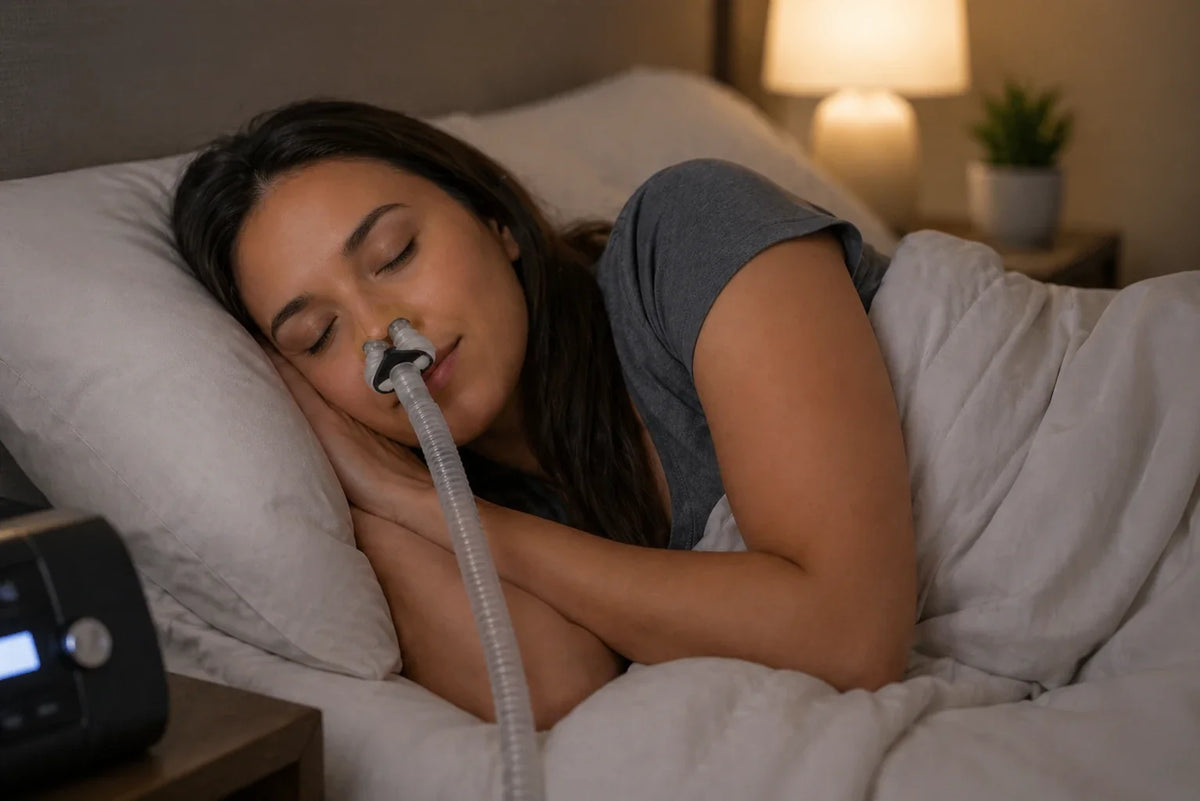
If you sleep on your side and breathe through your mouth, almost every standard CPAP mask recommendation will send you toward a full face mask. The logic seems straightforward: you breathe through your mouth, so the mask needs to cover your mouth. But if you have tried a full face mask as a side sleeper, you already know the problem.
Full face masks are bulky. They press into your pillow when you roll over, breaking the seal. The headgear shifts when you change position, pulling the cushion off-center. The larger contact area means more places for leaks to develop. And for a side sleeper who naturally moves during the night, the result is a cycle of waking, readjusting, and trying to fall back asleep that defeats the purpose of therapy entirely.
This guide breaks down what actually works for side sleepers who mouth breathe. It covers why the typical full face mask recommendation often falls short for this combination, what the real alternatives look like, and how to evaluate which approach fits your specific situation.
1. Why the Side Sleeper Plus Mouth Breather Combination Is Uniquely Difficult
Side sleeping and mouth breathing create two separate problems that each require different solutions. The trouble is that the conventional solution for one makes the other worse.
Mouth breathing during CPAP therapy means pressurized air escapes through your open mouth rather than staying in your airway. This drops your effective therapy pressure, causes dry mouth and sore throat, and shows up as elevated leak rates on your CPAP compliance data. The standard fix is a full face mask that covers both nose and mouth.
Side sleeping creates a different problem: anything with significant contact area on the face gets pushed out of position when your cheek hits the pillow. The cushion edge bears force it was not designed to handle for hours at a stretch. The headgear, running along the side of your face, gets caught between your head and the pillow. Full face masks have more contact area than any other mask type, which means they get displaced more aggressively by pillow contact than smaller masks do.
According to the American Academy of Sleep Medicine, mask leaks and discomfort are among the primary drivers of CPAP non-adherence. Side sleepers report disproportionately higher rates of mask displacement and leak events compared to back sleepers using the same equipment. Adding mouth breathing to the equation compounds both problems.
2. The Three Approaches to This Problem
Approach 1: Full face mask with top-of-head tubing
The most common recommendation for mouth-breathing side sleepers is a compact full face mask with a top-of-head tubing attachment. Models like the ResMed AirFit F30 and Philips DreamWear Full Face route the air hose from the top of the head rather than straight out from the front of the mask, which reduces the drag on the mask when you roll over.
This approach works reasonably well for some patients. The top tubing reduces one source of displacement. But the mask cushion and frame still have significant contact area, and the headgear still runs along the sides of the head. For active side sleepers or anyone with a tendency toward claustrophobia, the bulk of a full face mask remains a real obstacle to consistent use.
Approach 2: Nasal mask or nasal pillow with a mouth breathing solution
A lower-profile nasal interface paired with a dedicated mouth breathing solution keeps the mask footprint small while addressing the open-mouth problem separately. This is a less commonly discussed approach, but it often works better for side sleepers because it removes the pillow-contact problem by reducing the mask to a minimal nasal footprint.
The mouth breathing component can be addressed through SomnoSeal, a nasal breathing trainer that sits in front of your teeth and keeps your mouth gently closed during sleep. Unlike a chin strap, SomnoSeal works from inside the mouth without adding external pressure to the jaw or face. This combination, a low-profile nasal interface plus SomnoSeal, lets side sleepers stay in a comfortable, low-contact mask while keeping the mouth-leak problem solved.
SomnoSeal is available at bleepsleep.com alongside BleepSleep nasal interfaces, and pairing it with a low-profile design is one of the more practical paths for side sleepers who mouth breathe.
Approach 3: Headgear-free nasal interface
Headgear-free interfaces represent the most significant departure from conventional CPAP mask design. Without headgear, there are no straps to shift when you roll over, no cushion body to press into a pillow, and no frame running across your face. The interface sits at the nostrils and holds there through adhesive or magnetic-seal technology rather than strap tension.
BleepSleep's Eclipse CPAP Solution and DreamPort Sleep Solution are both headgear-free nasal interfaces. The Eclipse uses MagSeal technology with disposable Halos adhesive interfaces for a secure seal with no straps. The DreamPort fits at the nostrils with no inserts and no headgear of any kind. For side sleepers, removing headgear from the picture eliminates the primary mechanical cause of nightly displacement.
Paired with SomnoSeal to manage mouth breathing, a headgear-free nasal interface gives side sleepers both a low-profile design that stays in place through position changes and a solution for the open-mouth problem, without needing a full face mask.
3. How to Decide Which Approach Fits You
Start with your compliance data
Before switching mask types, pull your CPAP compliance report and look at what your leak data actually shows. If your current mask produces high leak rates consistently on side-sleeping nights, that confirms the displacement problem. If the leaks are high but not tied to position, mouth breathing may be the primary issue rather than mask fit. Your sleep specialist can help you interpret the data correctly, which avoids switching equipment in the wrong direction.
Identify your primary complaint
Patients who mainly struggle with mask displacement during side sleeping but tolerate their mask reasonably well otherwise are good candidates for a headgear-free interface. The goal is reducing the bulk that gets caught on the pillow, not necessarily changing the therapy route.
Patients whose main issue is dry mouth, raw throat, or high leak rates that persist even when they stay in one position are dealing primarily with mouth breathing. A full face mask solves that directly but adds mask bulk. A nasal interface plus SomnoSeal solves it while keeping the footprint small.
Patients dealing with both issues simultaneously, displacement from side sleeping and mouth-leak driven dry mouth, benefit most from the combination of a headgear-free nasal interface and SomnoSeal.
Consider your history with claustrophobia
If you have struggled with claustrophobia from any mask before, a full face mask is the least likely solution to work long-term. Claustrophobia from CPAP typically comes from the combination of full-face coverage and tight headgear, which is exactly what a full face mask provides. Low-profile and headgear-free designs remove both elements. For claustrophobic side sleepers who also mouth breathe, a headgear-free nasal interface paired with SomnoSeal is usually the most practical path to sustained compliance.
4. What to Ask Your Sleep Specialist
Before making any change, bring your compliance and leak data to your next appointment rather than describing the problem verbally. Specific numbers give your provider a clearer picture than a general description of the issue.
Useful questions to raise with your sleep specialist include: whether your leak data suggests primarily mouth leaks or seal displacement, whether a low-profile nasal interface at your prescribed pressure would be sufficient for your AHI, whether SomnoSeal is an appropriate option for your specific situation, and whether a headgear-free interface is covered under your current insurance plan.
Your provider can also request a prescription trial of a different interface type if your current setup has not been working. Many insurance plans allow for mask trials when there is documented evidence of compliance difficulty, so it is worth asking.
5. The Role of CPAP Pillows and Sleeping Position
CPAP pillows with cutouts for the mask and tubing can reduce displacement for some side sleepers, particularly those using compact nasal masks. They work by removing the solid pillow surface from the area where the mask makes contact, so the mask does not get pushed as it presses into the foam.
A CPAP pillow works best as a complement to a low-profile interface rather than a substitute for one. A headgear-free interface has so little bulk at the face that the pillow cutout is less critical. But for patients using a compact full face mask or nasal mask with some frame extension, a CPAP pillow can meaningfully reduce nightly displacement.
Frequently Asked Questions
What is the best CPAP mask for side sleepers who breathe through their mouth?
There is no single best option because the right mask depends on your primary complaint. If mask displacement is the main issue, a headgear-free nasal interface like BleepSleep's Eclipse or DreamPort removes the bulk that gets caught on the pillow. If mouth breathing is the primary driver of leaks and dry mouth, a nasal interface paired with SomnoSeal addresses both without requiring a full face mask. Many side sleepers who mouth breathe benefit from combining both approaches.
Do I have to use a full face mask if I breathe through my mouth during sleep?
No. A nasal interface paired with a mouth closure solution like SomnoSeal can address mouth breathing without requiring a full face mask. Whether this combination is appropriate for your therapy depends on your prescribed pressure and AHI, which your sleep specialist can confirm.
Why does my CPAP mask keep leaking when I sleep on my side?
Side sleeping puts direct pressure on the mask cushion and headgear from the pillow, pushing the interface out of position and breaking the seal. Masks with larger contact areas and more headgear are more susceptible to this. Switching to a low-profile or headgear-free interface removes most of the bulk that gets displaced, which typically reduces or eliminates side-sleeping leaks.
Can I use a nasal pillow mask if I breathe through my mouth?
Nasal pillow masks deliver therapy through the nostrils and do not cover the mouth. If you use one and breathe through your mouth during sleep, the pressurized air escapes through the open mouth rather than staying in your airway. Adding SomnoSeal to a nasal pillow mask setup keeps the mouth closed during sleep, which allows you to benefit from the lower profile of the nasal design while keeping the mouth-leak problem in check.
Is a headgear-free CPAP mask as effective as a traditional mask for treating sleep apnea?
Yes, when correctly fitted and used at the prescribed pressure. A headgear-free interface delivers the same continuous positive airway pressure as a traditional mask. The difference is how the seal is maintained. Your sleep specialist can confirm that a specific headgear-free design matches your prescribed pressure and AHI before you switch.
How do I know if my CPAP problems are from side sleeping or from mouth breathing?
Check your CPAP compliance data and compare high-leak nights to how you remember sleeping. Dry mouth and sore throat in the morning are strong indicators of mouth breathing. Mask-shaped marks on your face and mask that is visibly shifted when you wake point more toward side-sleeping displacement. Many patients have both issues, and your sleep specialist can help you interpret your compliance data to identify which is primary.
The Bottom Line
Being a side sleeper who breathes through your mouth does not mean you are stuck with a bulky full face mask. The combination of a low-profile or headgear-free nasal interface with a mouth closure solution like SomnoSeal gives you effective therapy in a setup that actually works with how you sleep, rather than fighting it.
BleepSleep's Eclipse CPAP Solution, DreamPort Sleep Solution, and SomnoSeal are all designed for patients who have not found what they need in conventional mask designs. Visit bleepsleep.com to explore the options and find out whether your insurance covers a switch to a headgear-free setup.
About the Author: Stuart Heatherington is the Founder, Executive Chairman, and Head of R&D/Product Design at Bleep Sleep and the inventor of the DreamPort Sleep Solution. With more than 30 years in the sleep industry and approximately 15 sleep apnea product patents, Stuart is a certified sleep technician, researcher, and long-time sleep apnea patient.
Frequently Asked Questions
What is the best CPAP mask for a side sleeper who breathes through their mouth?
A full-face hybrid mask that covers the nose with a low-profile cushion while allowing mouth access, or a nasal mask paired with a chin strap, tends to work best for side-sleeping mouth breathers.
Why do mouth breathers have trouble with standard nasal CPAP masks?
When the mouth opens during sleep, air escapes through the mouth rather than through the CPAP circuit, breaking the therapy seal and dramatically reducing the effectiveness of nasal-only CPAP delivery.
Can a mouth breather use a headgear-free nasal interface with CPAP?
Yes, if combined with a chin strap or nasal breathing trainer like SomnoSeal to prevent mouth opening. On their own, nasal-only interfaces are not suitable for consistent mouth breathers without an oral seal solution.
Does sleeping on your side make it harder to keep a full-face mask sealed?
Yes. Full-face masks can gap when pressed against a pillow, allowing air to escape around the seal. Low-profile nasal cushions or minimal-contact designs are less susceptible to pillow displacement.
How can I tell if I am a mouth breather during CPAP therapy?
Signs include waking with extreme dry mouth, throat soreness, high leak rate readings on your CPAP machine data, or your bed partner observing your mouth open during sleep.


