

The ResMed AirFit N20 has been one of the most widely prescribed nasal CPAP masks for years. It fits a broad range of face shapes, it is covered by most insurance plans, and its Infinity Seal cushion is designed to conform to different nose contours. For many CPAP users, it is the first nasal mask they try.
But after weeks or months of use, a significant number of N20 users start looking for something different. The headgear leaves pressure marks across the cheeks by morning. The nose bridge contact causes persistent soreness. Side sleeping means repositioning the mask through the night as the pillow compresses the headgear on one side.
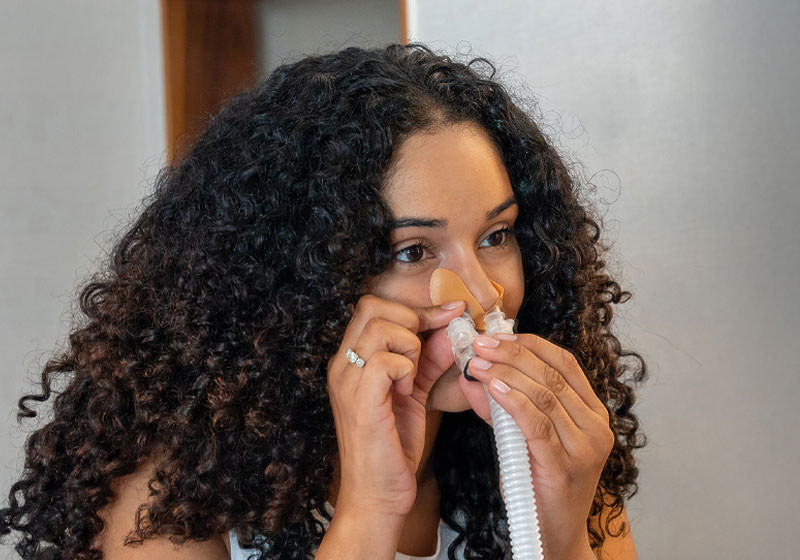
The Bleep Eclipse offers a structurally different approach: an adhesive interface that seals at the nostril rim with no headgear, no straps, and no silicone pressing against your face. This comparison walks through the key differences between the AirFit N20 and the Bleep Eclipse to help you decide which one fits your therapy and your sleep.
What Is the ResMed AirFit N20?
The AirFit N20 is a nasal mask that covers the nose but not the mouth. It uses ResMed's Infinity Seal cushion, a soft silicone shell that conforms to the contours of your nose under the tension of the headgear straps. The seal forms at the nose bridge, the sides of the nose, and the upper lip area.
The N20 comes in standard sizes (S, M, L) plus a Small for Her option. The headgear is a 5-point plush design with two upper straps, two lower straps, and a forehead pad. ResMed includes a Quick Release elbow so you can unplug the hose without disturbing the headgear fit.
The N20 is one of the most prescribed CPAP masks in the United States and is covered under standard Medicare and private insurance CPAP supply codes.
What Is the Bleep Eclipse?
The Bleep Eclipse is a CPAP interface that uses Halos™ adhesive patches, which are small, disposable patches that adhere to the skin at the edge of each nostril opening. The Eclipse connects to your CPAP hose via a MagSeal magnetic fitting that snaps into place and releases easily in the morning.
There is no headgear. No straps cross your cheeks, forehead, or chin. The adhesive patches hold the interface in position through the night, and the patches release from skin gently without pulling.
The Eclipse holds FDA 510(k) clearance (K172335). It is covered under Medicare and most private insurance plans as a CPAP nasal interface, typically under HCPCS code A7034.
1. Seal Technology: Cushion vs Adhesive
The N20 creates its seal through mechanical pressure. The Infinity Seal cushion is held in place by the headgear straps, which apply tension across the cheeks and under the chin. When the fit is calibrated correctly, the cushion conforms to the nose shape. When fit shifts due to repositioning in your sleep, headgear elastic stretching, or overnight changes in how the mask sits, leaks develop at the seal edge.
The Eclipse creates its seal through adhesion. The Halos™ patches bond to the skin at the nostril rim and maintain contact without depending on headgear pressure. The seal remains consistent regardless of sleep position because the interface moves with your face rather than being held in place by straps under tension.
For users who wake during the night due to air noise or pressure loss, the adhesive seal is a meaningful difference. It does not rely on headgear tension remaining perfectly calibrated through every sleep position you cycle through during the night.
What this means in practice: The N20 seal quality depends on how well your headgear is adjusted and stays adjusted. The Eclipse seal quality depends on how well the patch is applied. Patch application is a one-time nightly prep step rather than an ongoing calibration.
2. Headgear: Five-Point Straps vs None
The N20 5-point headgear is well-designed by traditional mask standards. The plush material is softer than many alternatives, and the magnetic clip makes putting it on straightforward. But any headgear introduces physical contact across your face and head for the entire night.
Over weeks and months of nightly use, common complaints with the N20 headgear include: pressure marks at the cheek strap contact points, forehead pad irritation, headgear elastic that stretches and loses tension over time, and difficulty maintaining the same fit night after night as the straps age.
The Eclipse has no headgear at all. There are no marks in the morning, no adjustment to maintain, and no elastic that degrades. The total contact on your face is limited to the Halos™ patch at each nostril rim and the small MagSeal connector, which is a fraction of the contact area of any strapped mask.
For side sleepers, the absence of headgear is particularly significant. When you roll onto your side with the N20, the pillow compresses one side of the headgear, which shifts the cushion and frequently breaks the seal. Many N20 users report that side sleeping requires more frequent mask readjustment than back sleeping. With the Eclipse, there is no headgear to compress into the pillow.
3. Contact Points and Skin Health
The N20 Infinity Seal contacts the skin at the nose bridge, both sides of the nose, and the upper lip area. The forehead pad adds contact above the nose. In total, the N20 covers a significant area of the central face for 7 to 9 hours each night.
For users with sensitive skin, rosacea, or acne in the contact zone, nightly mask use can worsen irritation. The warmth and pressure trapped under the silicone cushion create conditions that are not ideal for skin health over time. Cushion hygiene requires daily cleaning. Skipping a day or two shows quickly in terms of skin response.
The Eclipse contacts only the edges of the nostrils, which is a small, defined area. The rest of your face is completely uncovered. Users who switch from the N20 to the Eclipse frequently report that redness, pressure marks, and contact irritation resolve within the first week.
The Halos™ patches are single-use disposable. You apply a new patch each night, which eliminates the hygiene concerns that come with a reused silicone cushion. There is no mask-washing routine: replace the patches and you are done.
4. Noise and Pressure Management
The N20 operates quietly when the seal is intact. When the cushion loses contact from movement or headgear drift, the resulting air leak produces a hissing or whistling sound that disturbs sleep for both the user and any partner sharing the bed.
The Eclipse is designed to maintain consistent contact through the night because the adhesive does not shift. Users who sleep with a partner often find that the Eclipse lower noise profile during repositioning is one of its most noticeable practical differences from the N20.
Both interfaces are compatible with standard CPAP, APAP, and BiPAP machines. Pressure range compatibility should be confirmed with your sleep specialist based on your prescription.
5. Who Each Interface Is Best For
AirFit N20 is likely the better choice if:
- You are new to CPAP therapy and want a familiar traditional mask format your sleep clinic has experience fitting
- You sleep primarily on your back and do not change positions much
- You prefer a mask that your DME supplier can help you fit and adjust in person
- Your prescription involves higher pressures and you want a well-established mask type for your sleep study follow-up
Bleep Eclipse is likely the better choice if:
- You are dissatisfied with the N20 due to morning pressure marks, nose bridge soreness, or recurring leaks
- You are a side sleeper or active sleeper who rotates positions frequently
- You have sensitive skin or persistent irritation from the N20 contact points
- You want to simplify your nightly routine by eliminating mask washing
- You share a bed with a partner and want to reduce air noise during sleep
Side-by-Side Comparison
| ResMed AirFit N20 | Bleep Eclipse | |
|---|---|---|
| Interface type | Nasal mask (cushion seal) | Adhesive interface (nostril rim) |
| Headgear | 5-point plush headgear | None |
| Seal mechanism | Silicone cushion held by headgear tension | Halos™ adhesive patches |
| Face contact | Nose bridge, sides of nose, upper lip area, forehead | Nostril rim only |
| Side sleeping | Moderate (headgear compresses against the pillow) | Excellent (nothing compresses against the pillow) |
| Skin irritation risk | Moderate over time with daily contact | Low (single-use patches, minimal contact area) |
| Nightly prep | Headgear adjustment | Apply adhesive patch (~2 minutes) |
| Washing required | Daily cushion and headgear wash | No (patches are disposable) |
| Medicare coverage | Yes | Yes |
| FDA clearance | Yes | Yes (K172335) |
Frequently Asked Questions
How does the Bleep Eclipse seal without pressing against the outside of the nose?
The Halos™ adhesive patches bond to the skin at the edge of each nostril opening, which is the nostril rim itself. The seal forms at that point rather than against the outside surface of the nose. No external cushion pressure is required, which is why the interface works without headgear.
Is the AirFit N20 or the Bleep Eclipse better for side sleepers?
For most side sleepers, the Eclipse performs better. When you sleep on your side with the N20, the pillow presses against one side of the headgear, shifting the cushion and often causing a leak on that side. The Eclipse has no headgear to compress, so the seal position does not change when you roll over.
Will my insurance cover the Bleep Eclipse if I currently use the N20?
If you are covered under Medicare or a private plan for CPAP interface replacement supplies, you likely qualify for the Eclipse under standard HCPCS supply codes. BleepSleep handles insurance verification directly. Contact them through bleepsleep.com to confirm your specific coverage.
Can I try the Bleep Eclipse if I have never used an adhesive CPAP interface before?
Yes. BleepSleep provides setup guidance and DreamPreps™ skin prep materials to help new Eclipse users get the adhesion right from the first night. Most users reach a comfortable, consistent routine within about a week.
What is the main trade-off of the Bleep Eclipse compared to the N20?
The Eclipse requires a short nightly prep routine: cleaning the skin at the nostril rim and applying the Halos™ patches before bed. The N20 slips on in seconds once the headgear is sized. If the prep routine feels like too much of a change initially, keep in mind that eliminating mask washing and morning pressure marks tends to offset that for most users who make the switch.
Conclusion
The AirFit N20 is a reliable nasal mask and the right starting point for many CPAP users. But for users who have experienced headgear marks, nose bridge soreness, side sleeping leaks, or persistent mask fatigue, the Bleep Eclipse offers a structurally different solution: no headgear, no silicone cushion against the face, and no seal that depends on strap tension staying perfectly calibrated through the night.
The right choice depends on your sleep position, skin sensitivity, and how much the traditional headgear format is affecting your therapy experience. If the N20 is working for you, there is no reason to switch. If it is not, the Eclipse addresses the issues most N20 users encounter, and your insurance may already cover it.
Explore the Bleep Eclipse and verify your insurance eligibility at bleepsleep.com.
About the Author: Stuart Heatherington is the founder of BleepSleep, a direct-to-consumer medical device company specializing in mask-free and headgear-free CPAP solutions. BleepSleep's Eclipse™ and DreamPort® interfaces hold FDA 510(k) clearance and are designed for CPAP users who struggle with traditional mask discomfort, leaks, and therapy abandonment.


