
You wear your CPAP every night, but you still wake up with a dry mouth. Maybe your partner notices your mouth falling open. Or your machine keeps reporting leaks, even after you adjust your mask.
Would a CPAP chin strap help?
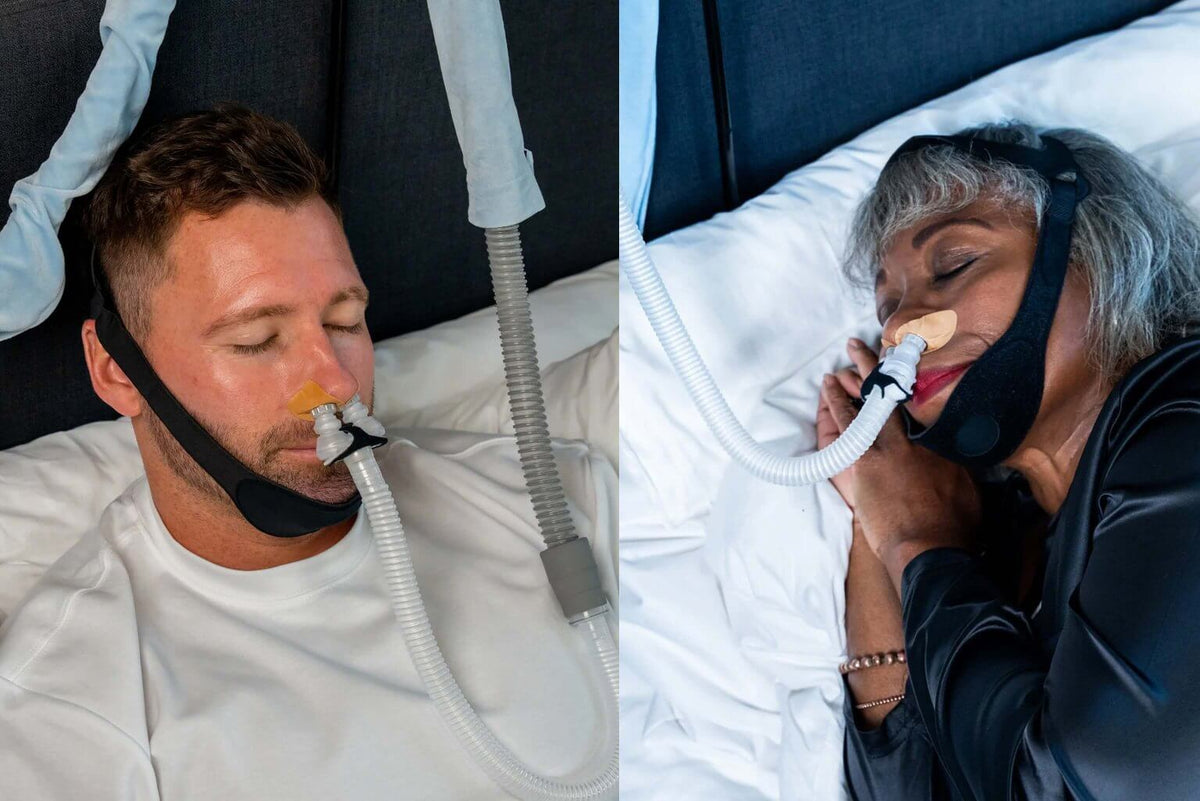
A CPAP chin strap supports your lower jaw and may reduce mouth leaks when your jaw drops open during nasal CPAP therapy. It does not fix a leaking mask cushion, clear a blocked nose or replace your CPAP treatment.
The useful starting point is finding out where the air is escaping. From there, you can choose an adjustment that addresses the problem.
What does a CPAP chin strap do?
A chin strap sits beneath your chin and wraps around your head to support your jaw while you sleep. It is commonly considered for people using a nasal mask or nasal pillows.
If your jaw relaxes and your mouth opens, air delivered through your nose can escape through your mouth. A strap may help limit that opening.
Mayo Clinic’s CPAP troubleshooting guide identifies a chin strap as one option for reducing mouth leakage with a nasal mask.
However, jaw support does not create an airtight seal between your lips. You can still have mouth leaks while wearing one.
That is why choosing a CPAP chin strap to keep your mouth closed should start with understanding the leak, rather than simply buying a tighter strap.
Is the leak coming from your mouth or your mask?
A dry mouth can suggest mouth leakage, but it does not prove it. Dryness can have other causes, including medication, nasal symptoms and humidification needs.
These observations can help you describe the problem to your equipment provider:
|
What you notice |
What to check |
|
Your partner notices your mouth opening while you use a nasal mask |
Whether jaw opening is contributing to mouth leakage |
|
Air blows toward your eyes or escapes around the cushion |
Mask position, cushion condition and sizing |
|
Leaks appear when you turn over |
Whether your pillow or tubing moves the mask |
|
Your nose feels blocked at bedtime |
Nasal breathing comfort before adding a chin strap |
|
Your device repeatedly reports high leakage |
Mask fit and therapy data with your provider |
A leak graph can help with troubleshooting, but a number or pattern alone does not reliably identify the source.
For a broader look at mask movement and seal problems, read our guide to common CPAP leaks.
When might a chin strap help?
As a longtime sleep apnea patient, I know how important it is to find a setup you can sleep comfortably with. I recommend considering a chin strap when your jaw drops open during nasal CPAP and contributes to mouth leakage, provided you can breathe comfortably through your nose. The strap supports your jaw, but air can still escape between your lips.
The evidence supports a measured expectation. In a small study of 15 nasal CPAP users, a chin strap reduced mouth leakage and related awakenings. However, problems remained, and some participants experienced increased snoring.
The practical takeaway: a strap can help some people, but its effect needs checking.
If your mouth feels less dry but your leak readings remain high, the problem may not be fully resolved. Likewise, lower leakage does not automatically mean your sleep apnea is adequately controlled.
When a chin strap is not the right fix
Adding jaw support will not solve every CPAP problem.
A leaking cushion needs attention at the mask.
Check the fit and condition of the cushion. Tightening your headgear harder can distort the seal and create more discomfort.
A blocked nose needs a different approach.
If nasal breathing is difficult, address the cause with your care team before trying to keep your mouth closed overnight.
Jaw pain is a reason to reassess.
A strap should not leave you fighting pressure against your jaw. If you have an existing jaw condition, ask about suitability before using one.
Persistent mouth leakage may require another interface.
A full-face mask may be considered when other adjustments do not adequately manage the problem. The American Thoracic Society’s mask-selection report emphasizes identifying the leak source and reviewing comfort and treatment outcomes when selecting a mask.
Persistent leaks can also affect how an automatic CPAP machine responds. Ask your sleep care team to review your leak data and pressure settings together to determine whether an adjustment is appropriate. Do not change prescribed pressure settings yourself.
How to Choose a Chin Strap for CPAP
The best choice is one you can wear comfortably with your existing setup. Before buying, check these details:
-
Sizing: Follow the manufacturer’s sizing guidance. “One size fits most” does not guarantee a comfortable fit for everyone.
-
Adjustment: Look for a design that allows appropriate support without excessive tension.
-
Contact points: Consider where the fabric and fasteners will touch your chin, cheeks and scalp.
-
Mask interaction: Check whether the strap could move your mask, press against its connections or interfere with the seal.
-
Care instructions: Make sure the cleaning and drying routine fits your daily schedule.
If you have a beard, ask about the particular design before ordering. Facial hair can affect how a strap sits, and a general product description may not answer that question.
At Bleep, we offer a Halo Style Chinstrap for jaw support during PAP therapy. It can be used with both Eclipse and DreamPort. Review the product details and ask our team about fit with your setup before choosing it.
How to wear a CPAP chin strap
Different CPAP chin straps use different strap paths and adjustment points. Follow the instructions supplied with your model. The checks below complement those instructions rather than replace them.
-
Confirm the correct orientation. Identify the chin support and each fastening point before putting it on.
-
Position it as directed. The support should sit where the manufacturer specifies, without slipping onto your throat.
-
Adjust for comfortable support. Avoid tightening it to force your jaw shut. Stop if it causes pain or makes breathing uncomfortable.
-
Check your complete CPAP setup. Make sure the strap does not displace your mask or cover its exhalation vents.
-
Try your usual sleeping position. With your CPAP running as prescribed, check whether lying down or turning your head changes the fit.
-
Review the result. Follow up on comfort, leakage and sleep disruption rather than assuming a snug fit means the problem is solved.
Should it go over or under your mask headgear?
There is no single answer for every strap and mask combination. Follow the instructions for both products or ask your equipment provider to demonstrate the fit.
To clean the Halo Style Chinstrap, wash it in warm soapy water, rinse thoroughly and allow it to air dry. Follow the care instructions supplied with your strap, and inspect it regularly for stretched fabric or worn fasteners.
What if air still escapes between your lips?
If a chin strap supports your jaw but air still escapes between your lips, there may be another option worth discussing with your sleep care team. SomnoSeal and MouthShield are oral devices designed to help limit mouth leakage during nasal CPAP. They sit inside the mouth rather than supporting the jaw from outside.
Ask your clinician whether an oral shield suits your needs before combining it with a chin strap. Both products require comfortable nasal breathing, and neither replaces your prescribed CPAP treatment. Follow the product’s instructions and warnings.
Chin straps versus mouth tape
A chin strap supports the jaw. Mouth tape attempts to keep the lips together. They work differently, and neither should be treated as a universal answer to mouth breathing.
A 2025 systematic review of mouth taping found limited evidence of benefit and identified potential serious risks, particularly with nasal obstruction.
Do not switch to mouth tape simply because a chin strap feels inconvenient. Discuss it with your sleep clinician first, especially if your nose becomes blocked at night.
Mouth tape is not a replacement for prescribed CPAP therapy.
Can you use a chin strap with Eclipse or DreamPort?
Yes. The Halo Style Chinstrap can be used with both Eclipse and DreamPort. These nasal CPAP systems use adhesive interfaces around the nostrils instead of conventional mask headgear.
Headgear-free attachment does not prevent mouth leakage. If your jaw drops open, a separate chin strap may help support it, although air can still escape between your lips.
Check that the chin strap does not disturb the adhesive seal or interface connections. Contact our team if you need help with your setup.
How do you know whether it is helping?
Look beyond whether your mouth stays closed.
After an adjustment, pay attention to:
-
Whether your device reports less leakage.
-
Whether you wake less often to adjust your equipment.
-
Whether dryness improves.
-
Whether the strap causes soreness, irritation or new discomfort.
-
Whether you can continue using CPAP throughout your sleep.
Discuss persistent leaks, worsening snoring or ongoing daytime sleepiness with your sleep care team. A comfortable setup and effective treatment need to go together.
Frequently asked questions
Can a chin strap for sleeping replace CPAP?
No. A chin strap supports your jaw; it does not provide the air pressure used to treat obstructive sleep apnea. Continue your prescribed treatment unless your clinician changes it.
Will a CPAP chin strap stop all mouth leaks?
No. It may help when jaw opening contributes to leakage, but air can still escape between the lips. It also cannot correct a leaking mask cushion or nasal blockage.
Can a chin strap help with dry mouth?
It may help if mouth leakage from jaw opening is contributing to dryness. Persistent dry mouth needs a closer look because leakage is not the only possible cause.
Choose support that addresses your leak
You should not have to keep adding accessories without knowing what they are meant to fix.
My advice is to choose support based on the problem you are experiencing. There is no single solution that suits everyone.
Explore our Halo Style Chinstrap, or ask the Bleep team about product fit and setup. For ongoing leakage or treatment concerns, bring your device data to your sleep care team so the next adjustment has a clear purpose.


