

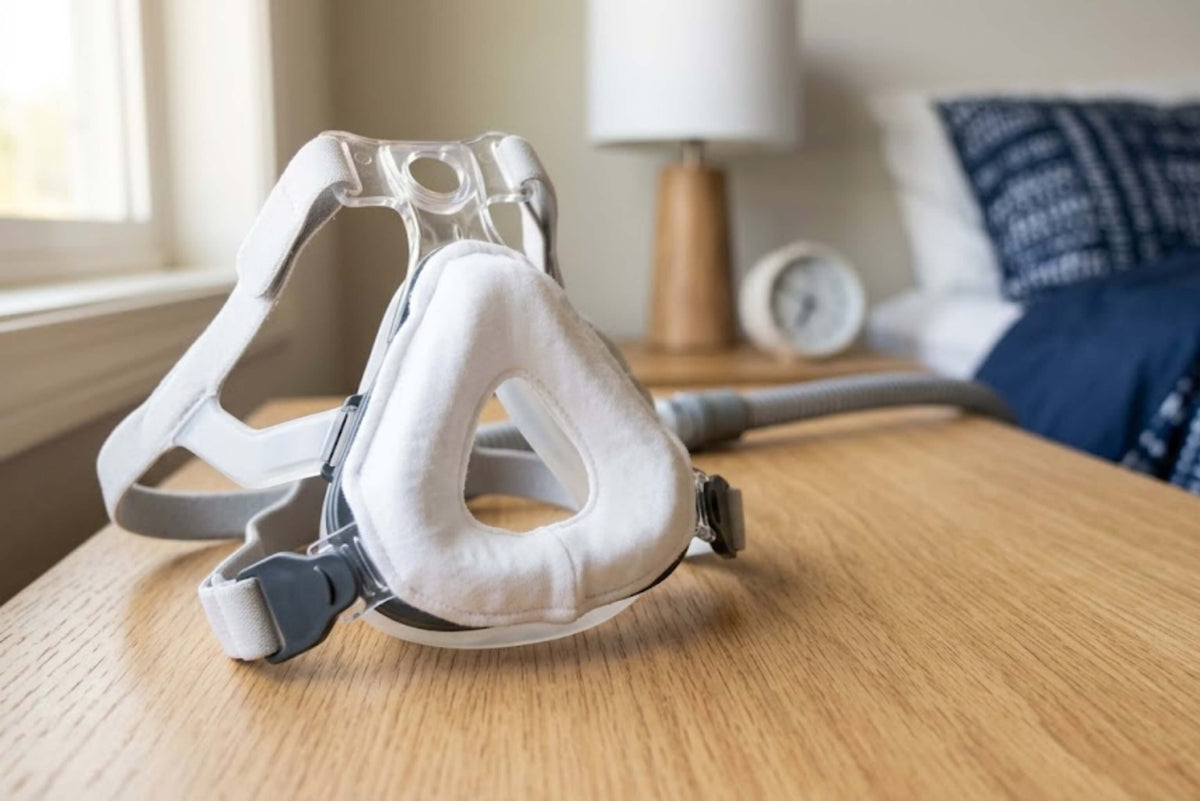
If you wear a CPAP mask, you have probably seen liners promoted as a fix for red marks, leaks and noisy nights. This guide explains what they do, when they help, when they do not, and what to try first.
Quick answer: A CPAP mask liner is a soft fabric layer that sits between your skin and the mask cushion. It acts as a barrier, absorbs moisture and skin oil, and adds a little cushioning. For many people, that means less redness and fewer pressure marks. Liners cannot fix a mask that does not fit, and for some people they make leaks worse.
Do CPAP mask liners actually work?
Often for comfort, less reliably for leaks. Most of what you will read about liners comes from the companies that sell them, and we did not find independent clinical studies that test them.
Here is what a liner is designed to do:
-
Act as a barrier. It keeps silicone from rubbing directly on your skin.
-
Control moisture. It absorbs sweat and facial oil, which can make a cushion slip. Sellers also say it slows cushion wear from skin oil.
-
Add cushioning. It spreads pressure along the edge of the cushion.
People who tend to benefit include those with sensitive or oily skin, hot sleepers, and anyone who wakes with pressure marks. If your mask already fits well and feels comfortable, you may not need one.
Experiences vary. On the CPAPtalk forum, some long-term users call liners essential, while others say they never got them to work.
Do liners cause or reduce leaks?
Both can happen, and the difference usually comes down to fit and placement.
How a liner can reduce leaks.
It can fill tiny gaps between the cushion and your skin. It also absorbs the moisture and oil that make a cushion slide around during the night.
How a liner can cause leaks.
A wrinkle or fold under the cushion can open a channel for air. A liner in the wrong size or shape can sit badly, slip, or cover your nasal opening. Some users report that a liner covered their mask’s vent holes, so check that yours leaves them clear. Some users also say a liner makes their mask feel tighter. Buyer reviews often mention liners that slip or partly block the nose, and one forum member reported leak numbers rising sharply after adding liners.
How to test it.
-
Change one thing at a time. Keep your pressure and settings the same.
-
Note your average leak numbers in your machine's app or report for a few nights without the liner.
-
Add the liner and compare a few more nights.
-
If leaks go up, remove the liner and recheck your mask fit.
Your sleep clinician can help you read the numbers. A liner can also make a leak quieter without making it smaller. Forum members describe loud leaks turning into a soft hiss, and one found their leaks were silent but still clear in the data, so judge by the numbers, not just by how the night sounded.
What types of CPAP mask liners are there?
There are four common types, and the main trade-off is convenience against upkeep.
|
Type |
How it attaches |
Example products |
Watch-outs |
|
Disposable fabric |
Sits between cushion and face |
RemZzzs |
Single use, thin, can slip |
|
Reusable, tabbed |
Repositionable tabs on the mask frame |
Silent Night |
Needs the right size for your mask |
|
Washable, stretch-fit |
Stretches over the cushion |
Snugell, Snugz |
Fit varies by mask, can lose shape |
|
Foam-padded |
Fabric with a foam layer |
EasyFormPro 3D |
Extra thickness may change how the cushion seats |
These are examples only, not a ranking or an endorsement. Liners also differ in material, from cotton to microfiber and stretch blends.
Which liner fits my mask?
Look for a liner made for your mask type, and check the exact model and cushion size. Liners are not interchangeable between full face, nasal and nasal pillow masks.
|
Your mask |
What to look for |
Note |
|
Full face |
Full-face liner sized to your cushion |
The most common type |
|
Nasal |
Nasal liner |
Check your exact model and size |
|
Nasal pillows |
A liner made for pillows |
Fewer options, but some retailers carry them |
|
Under-the-nose and minimal-contact masks (for example DreamWear, AirFit F30) |
Only a liner made for that exact mask |
Some makers say their general liners are not recommended for these masks |
|
Headgear-free adhesive interfaces |
No liner is used |
There is no cushion for a liner to cover (see below) |
How do I put on a CPAP mask liner?
Follow your liner's own instructions first. These steps cover what most liners have in common.
-
Wash your face and clean the cushion with mild soap, then dry both. Oil weakens the seal.
-
Line up the liner's opening over your nose and mouth. Attach any tabs or stretch it on as the maker directs.
-
Smooth out wrinkles. Folds can let air escape.
-
Put on the mask and set the headgear snug, not tight. Over-tightening causes marks and can break the seal.
-
Check that the liner is not covering vents or blocking your nasal opening. Breathe, then lie in your normal sleeping position.
-
If you hear a leak, lift the mask slightly, smooth the liner and re-seat it.
-
Check your leak numbers the next morning.
How often should I wash or replace a liner?
It depends on the type, and published advice is not consistent. Follow your liner's own instructions.
|
Liner type |
What sellers and clinics advise |
|
Disposable |
Replace every night |
|
Reusable, tabbed (for example Silent Night) |
About a week per liner; one retailer says do not wash between changes |
|
Washable (for example Snugell, Snugz) |
Retailers range from about 45 to about 90 days, washing in between |
|
Any reusable liner |
One clinic advises washing after each use and rotating two or more; another source says at least weekly, avoiding high heat when drying |
Whatever you use, wash your cushion daily with mild soap and warm water, and replace a liner when it frays, stretches or loses its shape.
What should I fix before buying a liner?
Check the cause of the problem first, because a liner cannot repair a poor fit. Run through this list:
-
Mask size and fit. A properly fitted mask is the best protection against leaks. Ask your provider for a refit if marks or leaks persist.
-
Cushion age. A worn cushion can leak even with a liner. Replace it on the manufacturer's schedule.
-
Headgear tension. Tightening to stop a leak often leaves marks and can make the seal worse.
-
Cleaning. Oil on your face and cushion breaks the seal. Clean both daily.
-
Sleep position and pillow. Side sleepers often get leaks when the pillow pushes the mask out of place. Our guide for side sleepers who breathe through their mouth covers this in more detail.
-
Pressure. If leaks started after a pressure change, tell your clinician. Do not adjust pressure yourself.
When to talk to a clinician.
Broken skin, a rash, swelling, pain, redness that does not fade, or persistently high leaks are reasons to call your provider rather than keep trying accessories.
A note from Stuart. Leaks can fragment your sleep and your bed partner’s. Check your leak data each morning to see how your mask performed. Keep in mind that no CPAP machine can tell where a leak comes from. It cannot separate a mask leak from a leak anywhere else the pressurized air travels: the tube, the mask, your mouth or the humidifier chamber. Mouth breathing is often misread as a mask leak, and our guide to SomnoSeal explains one option. In my experience, auto-adjusting machines can sometimes deliver more pressure than needed, which can make leaks worse. Talk with your clinician before changing any settings.
Is there an alternative to CPAP mask liners?
Good news: yes. Bleep Sleep makes headgear-free CPAP interfaces that need no liner, because there is no cushion pressing on your face. We offer two: the Eclipse and the DreamPort. Both connect to your existing CPAP machine, and both are built to remove the straps, marks and cushion contact that liners try to soften.

What are the Eclipse and the DreamPort?
The Eclipse pairs a reusable magnetic frame with disposable adhesive pads called Halos. The frame clicks onto the Halos at your nostrils, and nothing goes into your nostrils. It is the easier of the two to apply, and slightly more compact under the nose.
The DreamPort uses adhesive strips with a connector frame and meets at the nostril opening without entering the nostrils. It has a slightly lighter feel, takes a little more dexterity to apply, and works well for upward-flaring nostrils.
Which one fits you?
Nostril shape is the main factor. The Eclipse suits nostrils that sit more level to the ground. The DreamPort suits more angular noses. If you are unsure, contact our team for fitting guidance.
Hear from Bleep Sleep users
What does the routine look like?
Each night you clean the skin around your nose with a mild astringent such as DreamPreps or witch hazel. Soap and makeup remover leave oils that weaken the seal. Dry the skin, apply the Halos with firm pressure, then click on the frame. You need about 1/8 inch (2 mm) of smooth skin where the adhesive sits, so facial hair near the nostrils may need trimming. The Halos are replaced nightly. The frame is cleaned after each use and typically replaced about every 90 days. Step-by-step videos are on the instructions page. Bleep says applying the DreamPort takes less than a minute, as Sleep Review reported.
Who it may suit.
Bleep lists people with chronic mask leaks, headgear intolerance, sensitive skin, a side or stomach sleeping position, or who stopped CPAP because of discomfort.
Who is it for?
We designed these interfaces for people with chronic mask leaks, headgear intolerance or sensitive skin, for side and stomach sleepers, and for people who stopped using CPAP because of discomfort.
Things to know first
-
Adhesive does not suit everyone. Bleep says about 2% of people are sensitive to the tape and suggests testing a small piece on your arm first. If you have a sore from a previous mask, let it heal before starting.
-
Mouth breathers need a mouth tape or chin strap, and should discuss pressure with their physician. Our guide to SomnoSeal explains one option.
-
The Eclipse uses magnets. Bleep's guidance, as reported by Sleep Review, is to keep the mask at least 0.8 inches (about 2 cm) away from any active medical implant or device, such as a pacemaker, defibrillator, neurostimulator, cochlear implant or hearing aid. If you or a bed partner has one, ask your cardiologist first. Our guide to magnetic CPAP interfaces explains how they work.
-
Bleep states its interfaces are FDA cleared (510(k) record K172335), covered by Medicare and most private plans, and eligible for FSA and HSA payments. Coverage depends on your plan, so check with your provider or Bleep. [CLIENT TO APPROVE WORDING.]
-
Talk with your sleep clinician about whether a headgear-free interface suits your prescribed pressure.
Ready to leave liners behind? Explore the Eclipse or the DreamPort, or see how insurance and FSA/HSA work for you.
Quick FAQ
Do liners work with nasal pillow masks?
Some liners are made for them, though there are fewer options than for full face masks. Check compatibility with your exact mask.
Can I make my own liner?
We do not recommend it. Forum members who tried homemade liners, such as cut-up socks, report fraying, wrinkles that caused leaks, and fabric tickling the eyelashes. A purpose-made liner is cut to fit a specific cushion.
Do I need a prescription for liners?
Major retailers sell them without one, and some list them as FSA and HSA eligible. Check with your plan.
How long should I try a liner before deciding?
Give it a few nights. Change nothing else, then compare your leak numbers and how your skin looks in the morning.
The Bottom Line
Liners can make a mask more comfortable, especially for sensitive or oily skin, but they are not a cure for a poor fit, and they can cause leaks if they wrinkle or slip. Fix the basics first: size, cushion age, tension and cleaning. If the mask itself, with its straps and cushion contact, is the real problem, a headgear-free option is worth discussing with your sleep clinician.
This guide is general information, not medical advice. Talk with your sleep clinician about your therapy.The Bottom Line.
Sources
- Sleep Foundation, Best CPAP Mask Liners
- Sove CPAP Clinic, CPAP Mask Liners
- cpap.com, mask liners collection and FAQ
- CPAPsupplies.com, mask liners
- Sleep Review, liners comparison guide
- Sleep Review, EasyFormPro liners
- The CPAP Shop, Silent Night liners
- WellBefore, Snugz full-face liners
- CPAPtalk forum thread on liners
- Bleep Sleep, Eclipse, DreamPorts and DreamPreps
- FDA 510(k) record K172335
- Sleep Review, Bleep launches Eclipse CPAP mask
- Sleep Review, Bleep DreamPort Sleep Solution
- cpap.com, Understanding Your CPAP Leak Rate
-
CPAPtalk forum threads on liners and leaks: Pad-A-Cheek liner, liners and leak rates, liner and mask fit, liners and noisy leaks


