

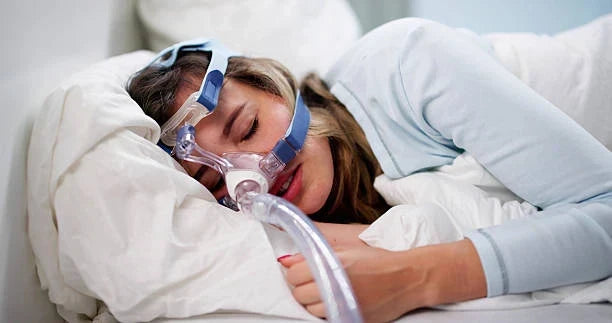
The short answer is yes. The longer answer is that it depends entirely on the mask.
Stomach sleeping with a CPAP machine is genuinely possible, but it exposes a fundamental design flaw in most conventional masks. The bulk, the frame, the straps, and the tubing position that work fine when your face is pointing up become active problems the moment you roll onto your stomach.
Around 7 to 16% of adults are stomach sleepers, according to multiple published surveys. That's a meaningful portion of the population, and many of them have sleep apnea. If you are in that group, the question of whether you can use CPAP while sleeping prone is not academic. It affects whether you can use your therapy at all.
Why Stomach Sleeping Is the Hardest Position for CPAP
When you sleep on your back or side, gravity and the pillow work with most CPAP mask designs. The cushion presses against your face with help from the headgear, the seal holds, and the therapy works.
Stomach sleeping reverses this. Your face is pressed downward into the mattress or pillow. The mask frame, which was designed to sit comfortably against a face pointing upward, now gets driven directly into the pillow surface. Depending on the mask type, this either collapses the seal entirely or creates a pressure point that makes stomach sleeping uncomfortable enough that you turn over and abandon the position.
Then there is the tubing. Most CPAP masks connect the hose at the front or side of the mask. When your face is down, the hose pulls the mask away from your face, torques the frame, and breaks the seal.
What Actually Happens to the Seal
The mechanics of a CPAP seal depend on a cushion making consistent contact with your face across its entire surface area. A small gap anywhere in that contact zone lets air escape, reduces therapy pressure, and can trigger your machine to ramp up in response. That cycle disrupts sleep even if you do not fully wake.
When you sleep prone, the downward pressure on the mask cushion is uneven. The center of the cushion gets compressed while the sides lift slightly. That creates gaps. The machine detects the leak. You wake up, or your sleep quality suffers without you realizing it.
For nasal pillow masks, which insert soft silicone cushions into the nostrils, the problem is slightly different. The pillows themselves may hold their position, but the headgear frame still wraps around the back of the head and connects to the sides of the mask. That structure can torque when pressed against a pillow and pull the pillows out of alignment.
The Advice You Will Find Everywhere: Use Nasal Pillows
Every article on this topic recommends nasal pillow masks for stomach sleepers, and that advice is partially correct. Nasal pillow masks have a smaller footprint than nasal or full face masks. There is less cushion surface to displace. The overall design is more compact.
But nasal pillow masks still have headgear. The straps run around the back of the head and connect to a frame at the nostrils. When you are face-down and pressing that frame into a pillow, the straps pull unevenly. The pillows shift. The seal fails.
Nasal pillows with a top-of-head tubing connection reduce the torque from the hose, which helps. But they do not remove the headgear problem. For genuinely active stomach sleepers, or people who spend most of the night in the prone position, nasal pillows are an improvement on full face masks but still fall short of a complete solution.
What Actually Works for Prone Sleepers
The most reliable approach for stomach sleeping with CPAP is to eliminate the two features that cause the most problems: the frame and the headgear.
A headgear-free, frame-free interface attaches directly at the nostrils without straps around the head. When you roll onto your stomach, there is nothing to catch on the pillow, nothing to torque, and no straps to shift. The interface stays in place because it is attached to the skin, not suspended in position by tension from a strap system.
This is the category where BleepSleep's interfaces sit. Both the Eclipse and the DreamPort are headgear-free. Neither has a frame that protrudes from the face. Both connect to standard CPAP tubing with minimal structure between the nostrils and the hose.
How the Eclipse Makes Prone CPAP Sleeping Practical
The Eclipse with MagSeal technology uses a patented magnetic seal at the entrance of the nostrils. It has no headgear, no frame running across the face, and no cushion that needs to be pressed against the skin with strap tension. The magnetic closure holds the interface in position through attraction between components, not through mechanical compression.
When you sleep on your stomach, the Eclipse sits flat against your nostrils without protruding significantly from the face. There is nothing for the pillow to catch. The magnetic seal maintains its integrity regardless of the direction your face is pointing because it does not depend on gravity or positional alignment to stay closed.
The Eclipse is FDA cleared (clearance number K172335) and compatible with standard CPAP tubing and machines. You do not need new equipment to use it.
The DreamPort is an adhesive-based interface that attaches directly to the skin around the nostrils using hypoallergenic surgical-grade adhesive. Like the Eclipse, it has no frame and no headgear. For stomach sleepers, it offers a completely flat profile with nothing to interfere with the pillow surface.
For a broader look at making CPAP therapy more manageable beyond mask selection, this guide on making CPAP easier to use covers additional adjustments worth knowing.
Practical Tips for Stomach Sleeping with CPAP
Choosing the right interface is the most important step. These additional adjustments can help further.
Use a thinner, firmer pillow. Thick pillows compress heavily when your face presses down, increasing the force on any interface. A thinner pillow reduces that compression and gives the interface more room to maintain its seal without fighting the pillow surface.
Route the tubing upward, not sideways. For any interface, routing the hose upward toward the head of the bed reduces the pulling force on the mask when you change positions. A hose clip on the bed frame or headboard can hold the tubing in a helpful position.
Allow a short adjustment period. Prone CPAP sleeping takes several nights to feel normal even with the right interface. Give it at least a week before deciding whether it is working. The first few nights often involve more awareness of the interface than you will notice once it becomes routine.
Check your machine's leak data. Most CPAP and APAP machines record per-hour leak data that you can review in the morning or through an app. Higher leak readings during the early part of the night (when you may start on your back) versus the later part (when you may shift prone) can tell you which position is causing problems.
Frequently Asked Questions
Is stomach sleeping bad for sleep apnea?
Not necessarily. A 2014 study published in the National Institutes of Health database found that 80% of people with positional obstructive sleep apnea saw significant improvements in apnea events when sleeping prone. Gravity pulls the tongue and soft tissue forward in the prone position, which can naturally reduce airway obstruction. CPAP therapy still addresses the apnea directly, so prone position is not a reason to stop using it.
Can I use any CPAP mask as a stomach sleeper?
Full face masks and most nasal masks are not practical for stomach sleeping because their frames press into the pillow and displace the seal. Nasal pillow masks work better but still have headgear that can shift. Headgear-free adhesive or magnetic interfaces are the most viable option for people who sleep primarily in the prone position.
Will stomach sleeping damage my CPAP mask?
Not if the mask is designed to accommodate movement. The primary risk is not damage but seal failure. Conventional masks may wear out faster at the cushion if consistently subjected to prone pressure, but the more immediate concern is that they stop sealing properly long before they wear out.
How do I keep my CPAP hose from tangling when I sleep on my stomach?
A longer hose (eight to ten feet instead of the standard six) gives more slack for movement. Routing the hose upward toward the headboard rather than sideways reduces the chance it pulls the mask out of position. Some users also use a hose suspension clip attached above the bed.
Does the Eclipse work at higher CPAP pressures for stomach sleepers?
Yes. The MagSeal closure is designed to maintain its seal across the pressure range used in standard CPAP and APAP therapy, including higher settings used for more significant apnea events. The magnetic connection does not become less secure as pressure increases.
Making Prone Sleeping Work with CPAP
Stomach sleeping with CPAP is not a niche problem or an impossible situation. It is a challenge that conventional mask design has not fully solved, but one that headgear-free interfaces address directly.
Untreated sleep apnea has documented consequences for cardiovascular health, energy, and cognitive function. Research on the relationship between sleep apnea and long-term heart health makes clear why finding an interface you can actually use in your preferred position matters.
If prone sleeping has kept you from using CPAP consistently, the Eclipse is designed for exactly that situation.


