
Skip to content
Free shipping on orders over $80.
Best CPAP Mask for Active Sleepers

Best CPAP Mask for Active Sleepers Who Toss and Turn

If you fall asleep on your back and wake up on your stomach, you already know the problem. Somewhere between those two positions, your CPAP mask shifted, the seal broke, and your therapy was running air into the room instead of your airway. You may not have even noticed until you woke up.

Active sleeping is more common than most people realize. Research from videotaped sleep studies shows that adults change their sleep position between 10 and 36 times per night, often without waking at all. For most people, that movement is completely normal. For CPAP users, every one of those shifts puts stress on the mask.

A cpap mask for active sleepers needs to solve a specific problem: maintaining a reliable seal across position changes, throughout the night, without waking you up or requiring you to readjust at 3am.

Why Conventional Masks Struggle with Movement

Most CPAP masks are designed around the assumption that you hold a reasonably consistent position during sleep. The seal is created by pressing a cushion against your face using tension from headgear straps. When the fit is right and you stay relatively still, this works well.

The issue for active sleepers is that every time you change position, several things happen at once. The straps shift slightly relative to your head. The frame rotates or tilts. The cushion loses contact with part of your face. Air finds the gap. And the seal that was working perfectly when you fell asleep is no longer doing its job.

With traditional masks, the only way to address this is to tighten the headgear more. But over-tightening brings its own consequences: facial marks, skin irritation, and pressure sores that make the mask uncomfortable enough to remove entirely.

What the Movement Problem Looks Like in Practice

For side sleepers, the pillow creates direct pressure on the side of the mask. This can rotate the cushion, collapse the frame against your face, and pull one side of the headgear tighter than the other. The seal on the compressed side often fails first.

For stomach sleepers, the problem is more significant. No conventional mask with a nose or face cushion handles true stomach sleeping well. The frame gets pressed directly into the mattress or pillow, and the seal has no chance of surviving that contact.

For back-to-side or side-to-back movers, the issue is the tubing. Standard CPAP tubing connects at the front or side of the mask. When you turn, the tubing pulls on the mask, torquing it out of position. This is one of the most common causes of position-related cpap mask movement leaks.

The Top-of-Head Hose: Helpful, Not a Complete Fix

Several major CPAP mask manufacturers have responded to the active sleeper problem by moving the tubing connection to the top of the head. This reduces the torque problem because the hose hangs vertically and can move freely as you turn.

This design is genuinely better for position changers than a front-connect mask. For sleepers who move between their back and sides, a top-connect mask can make a real difference in leak rates.

But it does not solve the underlying headgear problem. The straps still wrap around the head and shift with movement. The cushion still depends on strap tension to stay seated. For very active sleepers, particularly stomach sleepers or people who move more than average, the top-connect design is a partial improvement rather than a complete one.

A Different Approach: Remove the Headgear Entirely

The most direct solution to headgear movement is to remove the headgear. If there are no straps to shift, straps cannot be the reason your seal fails.

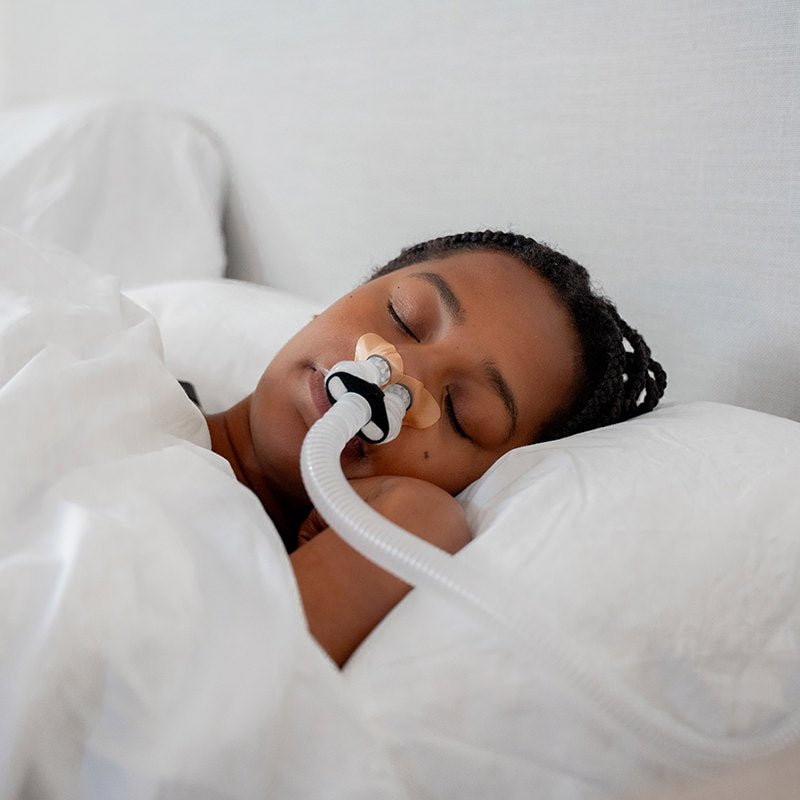
Headgear-free CPAP interfaces create and maintain their seal through a different mechanism entirely, either adhesive or magnetic attachment directly at the nostrils. Because the interface attaches to the face rather than being held in place by straps around the head, position changes do not affect how it sits.

When you roll from your back to your side, nothing shifts. When you turn to your stomach, there is no frame pressing into the pillow. The interface stays at your nostrils because it is attached to your nostrils, not suspended there by tension.

This is the design principle behind the BleepSleep Eclipse and DreamPort interfaces. Both are headgear-free. Both are specifically suited to active sleepers because they eliminate the failure point that position changes exploit.

BleepSleep Options for Active Sleepers

The Eclipse with MagSeal technology uses a patented magnetic seal to hold the interface at the entrance of the nostrils without straps, a frame, or a cushion that needs to be compressed into your skin. The MagSeal closure maintains its position whether you are on your back, side, or stomach, because it is not held in place by tension that changes when you move.

Because there is nothing on your head and minimal structure on your face, it does not catch on pillows or resist your movement during the night. The seal either works or it does not, and it does not depend on whether you stayed still.

The DreamPort is an adhesive-based interface that attaches directly to the skin around your nostrils using hypoallergenic surgical-grade adhesive. Like the Eclipse, it has no headgear. It connects to standard CPAP tubing with nothing else on the face. At under one ounce, it is light enough that you will not notice it when you move, and it stays where it is placed regardless of position.

Both interfaces are worth considering if you are a genuinely active sleeper who has already tried and failed with conventional masks. For an overview of other common barriers to consistent CPAP use, this post on making CPAP easier to use covers additional practical adjustments beyond mask choice.

Other Adjustments That Help Active Sleepers

Choosing the right interface is the most important variable. A few additional changes can support better therapy for people who move during sleep.

Use a longer hose. Standard CPAP tubing is around six feet. For very active sleepers, a longer hose (some go up to ten feet) gives the tubing more slack, reducing the chance that movement will pull on the mask and displace it. This applies to top-connect masks and headgear-free interfaces alike.

Try a CPAP pillow. Specialty CPAP pillows have cutouts on the sides that prevent the pillow from pressing on a mask frame. For side sleepers using a conventional mask, this can significantly reduce the displacement force that creates leaks. For headgear-free interfaces, it is less necessary since there is no frame to catch, but it can still add comfort.

Check your pressure data in the morning. Most CPAP machines log leak data by hour. If you see elevated leaks during specific parts of the night, that can tell you when you are moving most and where your seal is failing. Your prescribing doctor or sleep specialist can help you interpret this data and adjust settings if needed.

Frequently Asked Questions

What type of CPAP mask is best for side sleepers who move a lot? 

Low-profile nasal pillow masks and headgear-free interfaces are the two best options. Nasal pillow masks reduce facial coverage and work better with pillows than full face masks. Headgear-free interfaces like the BleepSleep Eclipse go further by removing the straps that shift during position changes.

Can I use a CPAP mask if I sleep on my stomach? 

Stomach sleeping is the most challenging position for conventional CPAP masks because the frame presses into the mattress or pillow. Headgear-free adhesive or magnetic interfaces are the most viable option for stomach sleepers because they have no frame and minimal facial contact.

Will tossing and turning make my CPAP therapy less effective? 

It can, if the mask loses its seal during position changes. A mask that stays sealed throughout the night delivers consistent therapy regardless of how much you move. Choosing an interface designed for active sleeping reduces the chance that movement will interrupt your therapy.

How do I know if my mask is leaking because of movement? 

Many CPAP machines record per-hour leak data. If you see higher leak readings during the second half of the night (when you may be in lighter, more restless sleep), that pattern often points to movement-related seal loss.

Is a headgear-free mask safe for people on higher pressure settings? 

Yes, when designed for that purpose. The Eclipse with MagSeal technology is FDA cleared (clearance number K172335) and designed to maintain its seal at therapeutic CPAP pressure levels, including settings used for more significant apnea events.

The Mask That Moves With You

For active sleepers, CPAP therapy does not have to be a nightly battle between your body and your mask. The right interface accounts for how you actually sleep rather than requiring you to change your sleeping habits to fit the equipment.

Consistent, uninterrupted treatment matters for more than just daytime energy. Research on the connection between sleep apnea and long-term heart health makes clear why getting therapy right every night is worth the effort.

If movement has been the reason your mask fails, explore the Eclipse range and find the configuration that fits your sleep.

Previous Post