

Quick takeaways
- Does a sleep apnea mouthpiece work? Yes, for some adults with obstructive sleep apnea. The most common type holds your lower jaw slightly forward while you sleep, giving air more room to pass through your throat.
- Can you use your regular night guard instead? A night guard protects your teeth from grinding. Even one custom-made by your dentist serves a different purpose from an appliance prescribed to treat sleep apnea.
- Could a mouthpiece replace your CPAP? It may be an option if you struggle to use CPAP or prefer an oral appliance. CPAP generally reduces breathing interruptions more. A follow-up sleep test can show how well a mouthpiece works for you.
How is a sleep apnea mouthpiece different from a night guard?
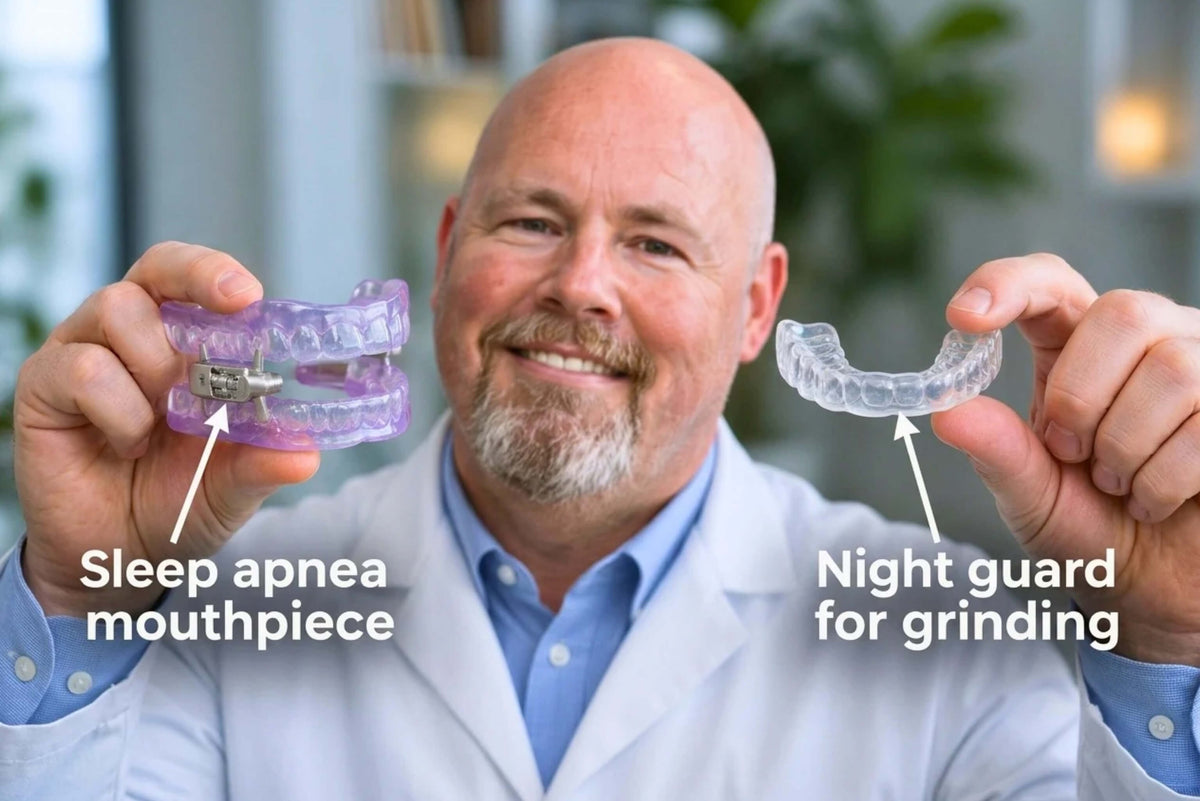
Look at the two devices in the photo above. The sleep apnea mouthpiece on the left has an upper tray, a lower tray, and a connector between them. The trays fit over your teeth, and the connector lets a dentist adjust how far forward your lower jaw rests. This type of mouthpiece is called a mandibular advancement device. Moving the jaw forward helps keep the airway open during sleep.
The night guard on the right is a single tray. It puts a protective layer between your upper and lower teeth when you clench or grind. A dentist can make either device to fit your mouth, which is why the words custom-fit alone tell you little about what a guard can do.
|
What to compare |
Custom jaw-advancing mouthpiece |
Regular grinding guard |
|---|---|---|
|
Why someone wears it |
To treat diagnosed obstructive sleep apnea |
To protect teeth from wear or damage caused by grinding |
|
What it does overnight |
Holds the lower jaw in a prescribed forward position |
Keeps the upper and lower teeth from grinding directly against each other |
|
How you know it is doing its job |
A sleep test measures breathing with the appliance in place |
A dentist checks the fit, wear on the guard, and condition of your teeth |
If you already own a night guard, ask the dentist who made it, "Was mine made for grinding or to treat sleep apnea?" That answer is more useful than trying to identify it by its shape or comparing it with photos online.
How well does a mouthpiece work compared with CPAP?
CPAP and a jaw-advancing mouthpiece take different approaches to the same problem. With obstructive sleep apnea, the airway repeatedly narrows or closes while you sleep. CPAP delivers air under pressure to hold it open. A mouthpiece changes the position of your jaw to make more room behind your tongue.
One way to compare them is to count how often breathing stops or becomes shallow during an hour of sleep. In studies reviewed by the American Academy of Sleep Medicine and the American Academy of Dental Sleep Medicine, CPAP reduced those events by about six more per hour, on average, than oral appliances did. That average helps explain why CPAP is generally the first choice for severe obstructive sleep apnea. Your own result will depend on how your airway responds to treatment.
If you regularly take your mask off halfway through the night, tell your sleep clinician what wakes you. "The strap pulls when I roll onto my side" gives your care team a different problem to solve than "I want a treatment I can use without a machine."
If headgear is the sticking point, a headgear-free nasal interface such as Bleep Eclipse lets you keep using CPAP while changing how the mask attaches. If you want to switch therapies, ask your clinician whether a prescribed oral appliance fits your diagnosis and what to use while it is being fitted and tested. Explore how Bleep Eclipse attaches.
Before making that switch, I would also want people to understand what wearing a mouthpiece can mean for their teeth and jaw. In my experience, dental discomfort is an important consideration, and it can be one reason people eventually stop using an appliance. Ask about these potential effects before deciding whether oral appliance therapy is right for you.
Is an over-the-counter mouthpiece worth trying?
Before buying a device advertised as a "sleep apnea mouth guard," read its intended use. Does the manufacturer describe protection from grinding, relief from snoring, or treatment for diagnosed obstructive sleep apnea? Those are three different claims. If snoring is what brought you here and you have never been evaluated for sleep apnea, start with your health care provider. A quieter night with a store-bought device cannot tell you whether your breathing is healthy during sleep.
For adults prescribed oral appliance therapy, the AASM and AADSM favor a custom, adjustable appliance fitted by a qualified dentist. Fit and adjustment do two different jobs. Fit describes how the trays sit on your teeth. Adjustment lets the dentist change how far forward your lower jaw sits. An at-home tray may mold to your teeth, but that fit alone cannot tell you which jaw position is comfortable or whether it improves your breathing. Read the AASM and AADSM guideline summary.
There is also a difference between a professionally fitted appliance and a boil-and-bite mouthpiece. In my experience, these at-home devices can be more challenging to fit properly and don't offer the same level of professional customization and adjustment. Because they sit directly against your teeth and influence your jaw position, proper fitting matters. I would encourage anyone considering oral appliance therapy to consult a dentist trained in dental sleep medicine rather than relying on an over-the-counter device.
What happens when a dentist fits a sleep apnea mouthpiece?
A dentist trained in dental sleep medicine checks your teeth, gums, bite, and jaw movement. This is the time to mention loose teeth, dentures, existing jaw pain, or dental work you have planned. If you grind your teeth, show the dentist the guard you already use so they can account for that when discussing your options.
Before starting treatment, I would ask one important question: Are you aware that a mandibular advancement device can cause tooth discomfort or soreness, changes in your bite, and TMJ or jaw pain?
These are potential side effects worth understanding before committing to an appliance. Some people experience discomfort in their teeth each morning, and others need to do jaw exercises to help their jaw return to its usual position after wearing the device overnight. Dental discomfort is also one reason some people eventually consider stopping treatment.
I want people to understand these possibilities before they start wearing a mouthpiece, rather than discovering them after treatment has begun. If you experience tooth pain, persistent jaw discomfort, or changes in how your teeth meet, speak with your dentist about the fit and adjustment.
The dentist takes impressions or scans for the appliance, checks how the finished trays sit, and guides adjustments as you get used to wearing them. Speak up if a tooth becomes sore, your jaw hurts, or your teeth start meeting differently when you bite down. The dentist can check whether the fit or jaw position needs attention. Regular dental follow-up also helps catch gradual changes in your bite.
If I stop snoring, how do I know the mouthpiece is working?
Your partner may be the first to notice that the room is quieter. The question a sleep test can answer is how many breathing interruptions still happen while you wear the appliance. Once you are comfortable with it and the dentist has adjusted the fit, your sleep clinician can arrange follow-up testing with the mouthpiece in place.
When you review the results, ask to see two numbers side by side: "How many breathing events did I have per hour on my original study, and how many did I have with the mouthpiece?" Then ask whether the remaining events need attention. That conversation gives you a clearer basis for continuing with the current setting, having the appliance adjusted, or discussing another treatment.
Can I wear a mouth guard with my CPAP mask?
It depends on what you want the device to do.
If you grind your teeth, ask your dentist and sleep care team about using your existing guard with your mask. Tell them if wearing the guard changes how your jaw rests or how the mask seals. The guard protects your teeth while CPAP delivers the airway pressure prescribed for you.
If you have a prescribed jaw-advancing appliance, some people use one alongside CPAP under clinical supervision. Ask who will adjust the mouthpiece and who will review your CPAP data. Keep using your prescribed settings unless your sleep care team changes them.
If air escapes between your lips during nasal CPAP, you may be looking for help with mouth leak. SomnoSeal, for example, sits inside the lips and is designed to help limit that leak while CPAP continues to deliver treatment. This is a different use of the word mouthpiece from a dental appliance that moves your jaw forward. Read Bleep’s guide to SomnoSeal and mouth leak.
How much does a sleep apnea mouthpiece cost, and does Medicare cover it?
When comparing prices, ask for a written estimate that covers the care around the appliance. One quote may include fitting and adjustment visits, while another lists those separately. Ask whether the dental exam and scans are included, who bills for the follow-up sleep test, and what you would pay if the appliance needed repair. Those details give you a figure you can actually compare.
If you have private insurance in the U.S., call your medical plan with the dentist’s name and the proposed device code. Ask whether the provider is in network, whether you need prior authorization, and what your share would be under your current deductible.
Original Medicare can cover a custom mandibular advancement appliance under code E0486 when its criteria are met. These include a clinical evaluation, qualifying sleep-test results, an order from the treating practitioner after reviewing the results, and a licensed dentist who supplies and bills for the device. The requirements vary with the sleep-study findings. If a dentist recommends an appliance, ask their office to check eligibility for your specific device before you commit to the cost. Read Medicare’s oral appliance coverage policy.
Frequently asked questions
Can I travel with a sleep apnea mouthpiece instead of my CPAP?
If follow-up testing has confirmed that the appliance controls your sleep apnea, ask your sleep clinician whether you can use it on its own for travel. If you are still having it fitted or adjusted, stick with the treatment plan you already know works until your clinician advises a change.
What if my teeth feel different in the morning?
Tell the dentist who fitted the appliance, especially if the change lasts into the day, keeps returning, or makes chewing uncomfortable. Describe what you notice, such as one tooth touching before the others when you close your mouth. Bring the appliance so the dentist can check how the trays fit and how your teeth meet.
Who should I see first for a sleep apnea mouthpiece?
If you suspect sleep apnea, start with your health care provider or a sleep clinician for an evaluation. If you already have a diagnosis and want to explore a mouthpiece, ask your sleep clinician about a referral to a dentist trained in dental sleep medicine. The dentist handles the fit and adjustments. Your sleep clinician checks how well the treatment controls your breathing. Read the American Thoracic Society’s patient guide to oral appliances.


