

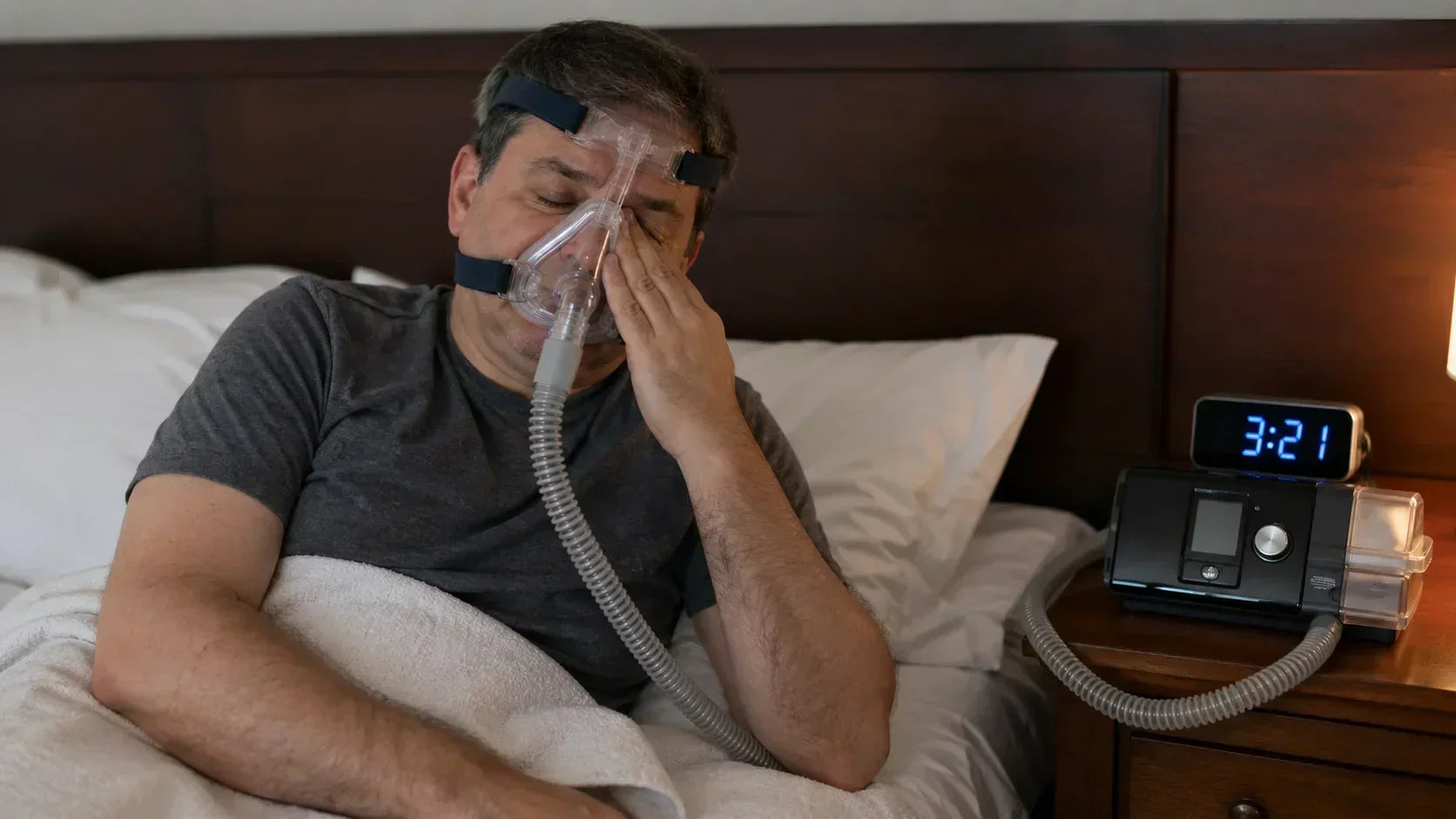
You wake up and your mouth feels like sandpaper. Your eyes are red, sticky, or blurry. You wore your CPAP mask all night. You did everything right. And you still feel worse than before you went to sleep.
These are not random side effects. They are symptoms of the same root problem: your mask is leaking, and that pressurised air is going somewhere it should not.
The best CPAP masks for people with dry mouth or dry eyes from leaks are those that eliminate the air leak pathway. That means either a headgear-free adhesive interface that removes the seal failure points altogether, or a well-engineered traditional mask that keeps escaping air away from the eyes and mouth. This guide covers all ten options, ranked by how effectively each one solves the problem at its source.
Why CPAP Leaks Cause Dry Mouth and Dry Eyes
Most CPAP users treat dry mouth and dry eyes as two separate problems. They are not. Both come from the same place: pressurised air escaping through a poorly sealed mask and travelling across the face.
Dry Eyes From Leaks
When a nasal or full-face mask does not seal properly at the nose bridge, air escapes upward and blows directly across the eyes throughout the night. A 2025 cross-sectional study published in Biomedicines found a statistically significant association between PAP mask leakage and dry eye indicators, confirming that airflow leaking from the CPAP mask directly affects tear film stability through continuous overnight evaporation. The result is eyes that are red, sticky, or painful in the morning.
Dry Mouth From Leaks
When air escapes around the mouth area, or when a nasal-only mask leaks and forces the user to breathe through their mouth, the constant airflow strips moisture from the oral tissues. A peer-reviewed survey of 744 CPAP users published in the Journal of Clinical Periodontology found that nearly 45% complained of dry mouth since beginning CPAP therapy.
The standard advice is to adjust the mask, tighten the straps, or add a humidifier. These are management tactics. They do not fix the underlying issue. The only real fix is a mask that does not leak in the first place.
Signs your leaks are causing your symptoms: Eyes that are red or blurry for more than 30 minutes after waking. Dry or sore throat despite using a humidifier. Waking with cracked lips or mouth breathing even with a nasal mask. CPAP data showing consistent large leak events throughout the night.
What to Look for in a Mask if You Have These Symptoms
Four things determine whether a mask will make these symptoms better or worse:
- Seal location. Masks that seal at the nose bridge are the primary cause of eye leaks. The escaping air has a direct upward pathway toward the eyes.
- Headgear design. Straps that cross the cheeks and temples shift during sleep, reopening seal gaps that direct air toward the eyes and mouth.
- Seal mechanism. Silicone cushions rely on strap tension. When that tension changes during sleep, the cushion lifts and air escapes. Adhesive seals rely on direct skin bonding and cannot lift away the same way.
- Coverage type. Nasal-only masks can cause dry mouth if the user opens their mouth during sleep. Full-face masks address mouth breathing but add more seal surface area, which creates more potential leak points.
The Top 10 CPAP Masks for Dry Mouth and Dry Eyes From Leaks
1. Bleep Eclipse — Best Overall
Best for: Users whose dry eyes come from nose-bridge leaks, active sleepers, anyone who has tried multiple masks and still wakes up with symptoms.
The Bleep Eclipse is a headgear-free adhesive interface from Bleep Sleep, a North Carolina-based FDA-cleared medical device company. Each night, disposable Halo patches made from 3M medical-grade hypoallergenic adhesive are applied to the skin around the nostrils. The Eclipse frame then clicks on magnetically via MagSeal technology in under a second. No straps. No headgear. Nothing crosses the face.
Because the seal is adhesive, there is no cushion edge to lift away from the skin. There is no gap for pressurised air to escape upward toward the eyes. The Eclipse is clinically shown to deliver the most stable seal in independent testing, with a 35% smaller profile than leading nasal pillow masks on the market. No upward air pathway means no dry eyes. No leaking air means no forced mouth breathing means no dry mouth.
Why It Solves the Problem:
- The adhesive seal has no cushion edge to lift and create an upward air leak
- No headgear means no straps to shift during sleep and reopen seal gaps
- Eliminates the air pathway toward the eyes entirely by design
- 35% smaller profile means less facial contact and less leak surface area
Honest limitation: Requires a 2 to 3 minute nightly routine applying patches to clean, oil-free skin. Most users reach full comfort within a week.
FDA-cleared. Covered by Medicare and most private insurance.
2. Bleep DreamPorts — Best for First-Time Switchers With Chronic Symptoms
Best for: Users who have been dealing with dry eyes or dry mouth for months, users with beards, those wanting the lightest possible interface.
The Bleep DreamPorts is the original Bleep product and the first adhesive CPAP interface ever brought to market. It uses medical-grade adhesive pads applied directly to the outside of the nostrils, connecting to a patented short tube system. There is no frame, no headgear, and no silicone cushion pressing against the face. There is no seal point between the nose bridge and the eyes that can open and direct air upward during the night.
Users consistently report resolution of dry eye and dry mouth symptoms after switching, with one noting they no longer woke up feeling like they had been in a wind tunnel all night after moving from a traditional nasal mask.
Why It Solves the Problem:
- No nose-bridge seal means no upward air escape pathway toward the eyes
- Adhesive bond does not shift during sleep, preventing leak recurrence
- Zero headgear means no straps to loosen and create new gaps overnight
- Compatible with beards as patches attach above the facial hair line
Honest limitation: Requires slightly more manual dexterity to apply than the Eclipse's magnetic connection. Some users move to the Eclipse after a few weeks for the easier nightly routine.
FDA-cleared. Covered by Medicare and most private insurance.
3. ResMed AirFit F40 — Best Full-Face Mask for Mouth Breathers With Dry Mouth
Best for: Mouth breathers whose dry mouth comes from air escaping through the mouth gap of a nasal-only mask, users who need full-face coverage.
The ResMed AirFit F40 is the smallest full-face mask currently available from ResMed. Its AdaptiSeal cushion seals under the nose rather than across the nose bridge, which moves the primary seal point away from the upward air pathway toward the eyes. For users whose dry mouth is caused by mouth breathing through the gaps of a nasal mask, a full-face mask eliminates that pathway by covering both the nose and mouth.
Why It Helps:
- Under-nose seal moves the primary seal point away from the eye zone
- Full-face coverage stops dry mouth caused by mouth breathing escape
- AdaptiSeal cushion molds to the face rather than pressing rigidly
- Magnetic clips allow instant removal for nighttime waking
Honest limitation: Still uses headgear and still has a silicone seal. The under-nose position improves but does not eliminate the possibility of upward air escape if the seal degrades during sleep.
4. ResMed AirFit P30i — Best Traditional Nasal Pillow for Reducing Eye Leaks
Best for: Nasal breathers whose dry eyes come from nose-bridge seal failures on traditional nasal masks.
The ResMed AirFit P30i uses nasal pillow inserts that enter the nostrils rather than pressing a silicone frame across the nose bridge. Because there is no nose-bridge cushion, there is no nose-bridge seal point to lift away and direct air toward the eyes. The top-of-head hose routing also reduces the tension placed on the mask seal during sleep, which is one of the key reasons nose-bridge seals fail throughout the night.
Why It Helps:
- No nose-bridge cushion removes the primary upward air leak pathway
- Top-of-head hose routing reduces seal tension during movement
- Nasal pillow sits inside the nostrils, not across the nose bridge
Honest limitation: Still uses headgear. Straps running along the temples can shift during sleep and affect pillow seal position. Users with beards may experience consistent seal failure at the nostril contact points.
5. Philips DreamWear Nasal Pillow — Best for Combination Sleepers With Dry Eye Symptoms
Best for: Active sleepers whose dry eyes come from mask displacement during position changes.
The Philips DreamWear routes its air pathway through a hollow soft frame that connects at the top of the head, keeping all hose bulk away from the face. The nasal pillow sits under the nose rather than covering it, removing the nose-bridge contact point that most commonly creates upward air leaks toward the eyes.
Why It Helps:
- No nose-bridge contact point eliminates the primary upward leak pathway
- Top-of-head routing reduces seal disruption during position changes
- Soft hollow frame minimises facial pressure that degrades the seal over time
Honest limitation: The hollow frame channels require thorough cleaning. Internal air path can be slightly noisier at higher pressure settings.
6. ResMed AirFit N30i — Best Nasal Cradle for Users Sensitive to Direct Nostril Airflow
Best for: Users whose dry eyes come from nasal-bridge leaks but who find nasal pillow inserts uncomfortable at higher pressure settings.
The ResMed AirFit N30i uses a nasal cradle that rests under the nose rather than covering it or inserting into it. This removes the nose-bridge seal point that creates upward air leaks. The redesigned softer silicone cradle flexes as users move during sleep, maintaining the under-nose contact and reducing the likelihood of the seal shifting open overnight.
Why It Helps:
- Under-nose cradle removes the nose-bridge seal failure pathway toward the eyes
- Top-of-head hose routing reduces movement-related seal disruption
- Flexible silicone adapts to position changes rather than resisting them
Honest limitation: The cradle seal is position-sensitive. Incorrect re-positioning after getting up at night can create new leak points if the cradle is not properly re-seated.
7. ResMed AirTouch N20 — Best Memory Foam Option for Sensitive Skin Users With Dry Eyes
Best for: Users with facial skin sensitivity who also experience dry eyes, users at higher pressure settings who need a more forgiving seal.
The ResMed AirTouch N20 uses an UltraSoft memory foam cushion rather than silicone. Memory foam conforms to the face rather than pressing against it, which reduces the gaps that form at the nose bridge as silicone cushions degrade during sleep. A seal that holds its shape throughout the night is a seal that is less likely to open an upward air pathway toward the eyes.
Why It Helps:
- Memory foam conforms to facial contours throughout the night rather than stiffening
- More forgiving of facial movement than silicone, maintaining seal longer
- Reduces nose-bridge pressure sores that force users to loosen the mask and create gaps
Honest limitation: Memory foam cushions cannot be submerged in water. They require daily wiping and monthly replacement. Higher ongoing cost than silicone alternatives.
8. Fisher and Paykel Nova Micro — Best Lightweight Option for Users With Both Symptoms
Best for: Users who experience both dry eyes and dry mouth, users with narrower facial profiles.
The Fisher and Paykel Nova Micro uses soft MicroPillows that nestle gently within the nostrils and inflate to conform to the nose shape. Because the MicroPillows inflate to match the nostril shape, the seal is more adaptive and less dependent on strap tension than a standard silicone cushion. This reduces the seal degradation that allows air to escape toward the eyes over the course of the night.
Why It Helps:
- Inflating MicroPillows adapt to nose shape rather than relying on static strap tension
- No nose-bridge contact point eliminates the primary upward leak pathway
- Compact frame means less surface area for seal failures to develop
Honest limitation: Requires correct cushion sizing. An incorrect size will cause the MicroPillows to either under-seal or over-seal, creating leak points that defeat the purpose.
9. ResMed AirFit N20 — Best Full-Coverage Nasal Mask for High-Pressure Users
Best for: Users who require higher CPAP pressure settings and experience dry mouth from increased airflow drying the oral cavity.
The ResMed AirFit N20 uses an InfinitySeal silicone cushion designed to adapt to facial contours during sleep. For users at higher pressure settings, where seal integrity is under more mechanical stress, the InfinitySeal design maintains consistent contact with the face better than a standard silicone cushion. A consistent seal means less air escaping toward the eyes and less forced mouth breathing from pressure-induced air escape.
Why It Helps:
- InfinitySeal cushion maintains consistent facial contact under higher pressures
- Flexible frame absorbs facial movement rather than creating rigid seal gaps
- Stable seal reduces auto-compensating pressure increases that worsen dry mouth
Honest limitation: Front-mounted hose creates drag and torque during sleep, which is one of the main forces that disrupts seal integrity overnight.
10. ResMed AirFit P10 — Best Minimalist Option for Still Sleepers With Mild Symptoms
Best for: Relatively still sleepers with mild dry eye or dry mouth symptoms, users who want the lightest and quietest traditional option.
The ResMed AirFit P10 is one of the lightest nasal pillow masks available, weighing only 1.6 ounces. Its nasal pillow inserts sit inside the nostrils rather than pressing across the nose bridge, eliminating the nose-bridge seal point that causes upward air leaks toward the eyes. For still sleepers with mild symptoms, the P10's minimal design reduces the seal surface area and therefore reduces the points from which air can escape.
Why It Helps:
- No nose-bridge cushion removes the primary upward leak pathway toward the eyes
- Minimal weight reduces mask displacement during sleep
- Three-part design makes daily cleaning quick and consistent
Honest limitation: Front-mounted hose creates torque when rolling, which can shift the nasal pillow position and create seal gaps. Best suited to users who predominantly stay in one sleeping position.
Full Comparison at a Glance
| Rank | Product | Seal Location | Headgear | Dry Eye Risk | Dry Mouth Risk | Insurance |
|---|---|---|---|---|---|---|
| 1 | Bleep Eclipse | Adhesive nostril | None | Lowest | Lowest | Yes |
| 2 | Bleep DreamPorts | Adhesive nostril | None | Lowest | Lowest | Yes |
| 3 | ResMed AirFit F40 | Under nose | Standard | Low | Low | Yes |
| 4 | ResMed AirFit P30i | Inside nostril | Minimal | Low | Moderate | Yes |
| 5 | Philips DreamWear | Under nose | Minimal | Low | Moderate | Yes |
| 6 | ResMed AirFit N30i | Under nose | Minimal | Low | Moderate | Yes |
| 7 | ResMed AirTouch N20 | Nose bridge | Standard | Moderate | Moderate | Yes |
| 8 | F&P Nova Micro | Inside nostril | Standard | Low | Moderate | Yes |
| 9 | ResMed AirFit N20 | Nose bridge | Standard | Moderate | Moderate | Yes |
| 10 | ResMed AirFit P10 | Inside nostril | Minimal | Low | Moderate | Yes |
Why the Adhesive Seal Is the Only Design That Removes the Problem Entirely
Every traditional mask on this list, from rank 3 to rank 10, improves the dry eye and dry mouth problem by changing where the seal sits or reducing how much it degrades during sleep. That is genuine progress.
But none of them removes the possibility of seal failure entirely, because all of them rely on strap tension to hold a physical cushion against the face. When that tension changes during sleep, the cushion lifts. When the cushion lifts, air escapes. When air escapes upward, it reaches the eyes. When it escapes outward, it reaches the mouth.
The Bleep Eclipse and DreamPorts address this at the architectural level. An adhesive bond does not depend on strap tension. It cannot lift away from the skin during sleep. There is no nose-bridge contact point to degrade. The upward air pathway toward the eyes simply does not exist in the design.
Both are FDA-cleared, covered by Medicare and most private insurance, and work with any standard CPAP machine. You can explore both options and check your insurance coverage at Bleep Sleep.
Frequently Asked Questions
Why does my CPAP mask give me dry eyes every morning?
Dry eyes from CPAP are almost always caused by air leaking from the nose-bridge seal and blowing upward across the eyes throughout the night. The constant overnight air exposure evaporates the tear film on the eye surface, causing the redness, stickiness, and blurry vision many users experience on waking. The fix is a mask that eliminates the nose-bridge seal point entirely.
Why does my CPAP mask give me dry mouth even when I use a humidifier?
A humidifier adds moisture to the air flowing through the machine. But if that air is escaping through mask leaks rather than entering the airway properly, the added moisture also escapes with it. Dry mouth from leaks is caused by the air pathway, not the humidity level. Fixing the seal fixes the dry mouth more reliably than adjusting the humidifier setting.
Do headgear-free CPAP masks prevent dry eyes?
Yes, by design. Adhesive interfaces like the Bleep Eclipse and DreamPorts have no nose-bridge cushion that can lift away and create an upward air pathway toward the eyes. Because the seal is adhesive rather than tension-based, the mechanism that causes dry eyes in traditional masks does not exist in the design.
Does insurance cover Bleep Sleep products?
Yes. Both the Eclipse and DreamPorts are covered by Medicare and most private insurance plans. Bleep also accepts VA benefits. Check your specific coverage on the Bleep Sleep insurance page.
Final Thoughts
Dry mouth and dry eyes from CPAP are not minor inconveniences. They are signals that your mask is leaking and your therapy is not being delivered as prescribed. The air that should be treating your sleep apnea is instead spending the night blowing across your eyes and drying out your mouth.
Every mask from rank 3 to rank 10 on this list represents a genuine improvement over a poorly fitting traditional mask. But improving a leak-prone design is still working around the problem, not solving it.
The Bleep Eclipse and DreamPorts remove the design feature that causes the problem: a headgear-tensioned cushion with a nose-bridge seal that lifts away during sleep. If you have been waking up with red eyes and a dry mouth for longer than a few weeks, the equipment is the issue. Visit Bleep Sleep to explore both options and check your insurance coverage before adjusting anything else.


