

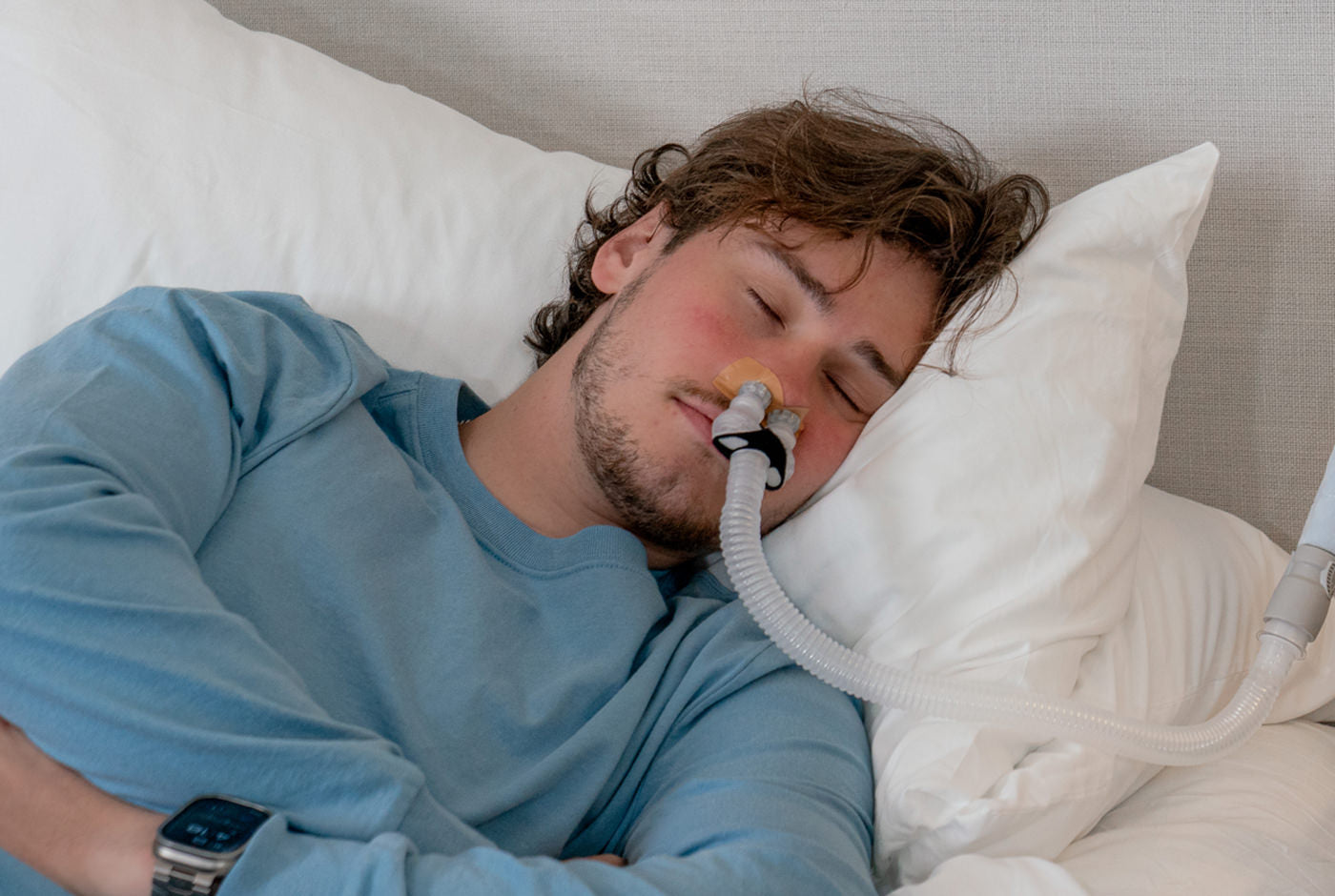
If you have a beard, a goatee, or even heavy stubble, you've probably noticed that your CPAP mask leaks more than it should. You tighten the headgear, you reposition the cushion, and it still hisses air all night. The problem isn't your mask size. It's the fundamental design of the silicone cushion itself.
Silicone seals need uninterrupted contact with your skin to work. Facial hair breaks that contact. No matter how compliant the silicone, it can't bridge the micro-gaps that beard and stubble create between the cushion and your face. The result is air escaping at pressure, a lower-quality therapy session, and frequently, a mask that wakes you up when it slips.
Adhesive CPAP interfaces solve this at the source. Instead of pressing a cushion against your beard and hoping for a seal, they bond to the small area of bare skin at and immediately around your nostrils, where most people have little to no facial hair. This guide explains why the physics of the silicone seal makes beards a persistent problem and how adhesive interfaces change the equation.
Why Silicone CPAP Cushions and Beards Don't Mix
A standard silicone CPAP cushion creates its seal by pressing against the surface of your face. The cushion needs a continuous line of skin contact to hold back pressurized air. Even a small gap allows air to escape, and because CPAP therapy delivers air at a sustained pressure, even tiny gaps become significant leaks over the course of a night.
Beard hairs physically prop the cushion away from your skin. The longer and denser your beard, the larger those gaps become. Light stubble creates small, frequent gaps. A full beard creates a discontinuous seal that's essentially impossible to maintain under pressure. Tightening the headgear compresses the hair and temporarily reduces the gap, but it also puts more pressure on your face and may distort the cushion shape, creating new leak points elsewhere.
Memory foam cushions perform better than standard silicone because they conform more closely to irregular surfaces, but they still require contact with skin to create a true seal. They're an improvement, not a solution. The underlying problem remains: any interface that relies on pressing against the full surface of your lower face will struggle in direct proportion to how much hair is in the way.
Where Adhesive Interfaces Work Differently
Adhesive CPAP interfaces don't press against your beard at all. They seal at a different location entirely: the skin directly at and immediately around your nostrils. For the vast majority of men with facial hair, this zone is either bare or has only fine, sparse hair that doesn't interfere with adhesion.
The adhesive bonds directly to skin rather than pressing against a surface. This creates a seal that doesn't depend on compressing or bridging hair. If the contact area is clear skin, the seal holds regardless of what your beard looks like two inches lower on your face.
The Eclipse CPAP Solution from Bleep Sleep uses this approach. Its MagSeal interface seals at the nostrils rather than across the cheek, jaw, or upper lip area where beards create the most interference. Men who have struggled with chronic leaks from traditional masks often find that the Eclipse provides their first consistently sealed therapy experience. You can see how the Eclipse CPAP Solution works and what makes it different from conventional mask designs.
The Specific Ways Beards Cause CPAP Problems
Nasal Mask Leaks Around the Upper Lip
Nasal masks cover only the nose but extend down to just above the upper lip. This is exactly where mustaches live. A mustache or goatee creates a gap precisely at the bottom edge of the nasal cushion seal, which is one of the highest-pressure points in the mask's contact area. Even a well-fitted nasal mask can produce significant upper-lip leaks with any notable mustache growth.
Full Face Mask Leaks Along the Jaw and Cheeks
Full face masks cover the nose and mouth and extend across a wide area of the face. More surface area means more opportunities for beard hair to interrupt the seal. A full beard creates gaps across the chin, the jaw line, and the cheeks simultaneously. Tightening the mask enough to compensate typically results in red marks, skin pressure, and discomfort that makes it difficult to sleep.
Nasal Pillow Instability with Heavy Growth
Nasal pillow masks insert soft silicone tips just inside the nostrils and are often recommended for beard users because they contact less of the face. However, the tips still rest against the skin at the base of the nostrils. Heavy stubble or a full beard growing toward the nostrils can push the pillow tips out of position during sleep, causing the seal to break when you shift positions. The mask may stay in place when you first lie down but drift and leak by the time you wake up.
Common Workarounds and Why They Fall Short
Most advice for CPAP users with beards falls into a few categories: trim more frequently, use mask liners, apply skin care products to smooth the hair, or switch to a mask with memory foam. Each of these helps to some degree. None of them resolves the fundamental issue.
Frequent Trimming
Trimming the beard shorter reduces the gap between the cushion and skin. But it requires a specific grooming schedule timed around your CPAP use, and many users report that even close-cropped stubble is enough to produce noticeable leaks. Growing past a certain length means the problem returns within days. For men who want a full beard, this isn't a sustainable answer.
Mask Liners
Fabric mask liners sit between the silicone cushion and your skin. They can slightly improve the seal with light stubble by providing a softer, more flexible surface. With a full beard they typically make little difference because the issue is the depth of the hair, not just the stiffness of the cushion material.
Skin Conditioners and Beard Oils
Some users apply lanolin or beard oil to soften and flatten facial hair before putting the mask on. This can marginally improve seal quality in some cases. The effect is inconsistent and washes off, meaning you need to reapply every night. It also doesn't change the geometry of what's happening: hair is still holding the cushion away from skin.
These are all adaptations to work around a design limitation. An adhesive interface removes the limitation rather than working around it. Because it seals at the nostril rather than across the beard area, you don't need to manage your beard to make your CPAP work.
What Effective CPAP Therapy Requires
CPAP therapy only works when the pressure is maintained throughout the night. A leaking mask reduces the effective pressure delivered to your airway, which means your apnea events may not be adequately controlled even though the machine is running. According to the American Academy of Sleep Medicine, consistent mask seal quality is one of the primary factors in whether CPAP therapy achieves its intended therapeutic effect.
For beard users, this often shows up as a pattern of partial therapy. The mask starts the night well-sealed, leaks develop as you move and as headgear loosens slightly, and by morning the therapy data shows pressure inconsistencies. Many users interpret this as the machine not working, when the real cause is a seal that couldn't hold through the night.
Understanding why reliable CPAP use matters for your broader health is worth taking seriously. Our overview of how sleep apnea impacts heart health covers what inadequate therapy means for long-term cardiovascular risk.
Who Benefits Most from an Adhesive Interface
Adhesive interfaces aren't exclusively for beard users, but beard and facial hair users are among those who see the most dramatic improvement over traditional mask types. Specifically:
Men with full beards who have given up on CPAP therapy because no mask would seal consistently. Men with goatees or mustaches who experience chronic upper-lip leaks with nasal masks. Men with stubble who don't want to shave daily but can't get a stable seal with silicone. Men who've tried multiple nasal pillow options and still experience positional leaks when they move during the night.
If you've been told by a sleep technician or equipment supplier that your beard is the reason your CPAP isn't working and that shaving is the only solution, an adhesive interface is worth examining carefully. Many beard users find it resolves in a single night what years of mask adjustments couldn't fix.
More practical strategies for staying on therapy are covered in our post on how to make CPAP easier to use, which includes tips beyond just equipment selection.
What to Know Before You Switch
Before moving to an adhesive interface, a few practical points are worth knowing.
The contact area still needs to be clean and dry
Adhesive bonds to skin, not to oil or moisturizer. Wash and dry your face before applying the interface each night, particularly around the nostrils. Most users make this a standard part of their pre-sleep routine within a few days.
Very dense nostril-area hair may still cause issues
For most men, the skin immediately around the nostrils is clear enough for a good adhesive seal. If your facial hair grows into that zone heavily, test one interface for a few nights to see how the seal holds before committing to a full supply.
There is a short adjustment period
The sensation of an adhesive interface is different from any mask you've worn before. Most users adapt within two to four nights. The primary adjustment is simply getting used to a very lightweight, strap-free experience rather than the familiar pressure of a traditional mask.
Frequently Asked Questions
Does an adhesive CPAP interface work with a full beard?
Yes, for most men with full beards. The adhesive bonds to the skin at the nostrils, which is typically clear of beard growth. The beard itself, including the mustache area and cheeks, is not involved in the seal at all. This is the core reason adhesive interfaces outperform silicone for beard users.
Will the adhesive irritate my skin?
Bleep Sleep's interfaces use a hypoallergenic surgical-grade adhesive designed for nightly skin contact. Users with sensitive skin occasionally experience mild redness during the first few nights as they adjust. If you have a known adhesive sensitivity, test one interface on a small skin area first before using it nightly.
Do I still need to manage my beard at all?
Minimal maintenance. The only area that matters is the small zone immediately around your nostrils. As long as that skin area is clean, dry, and accessible, your beard can be any length or style without affecting the seal quality.
Can I use an adhesive interface if I have sensitive skin?
Many users with sensitive skin use adhesive interfaces without issues because the contact area is small and the adhesive is hypoallergenic. If you have eczema, psoriasis, or a known skin condition around the nostrils, consult your doctor before starting nightly adhesive use.
How does the Eclipse compare to nasal pillow masks for beard users?
Nasal pillow masks still require the pillow tips to rest against the skin at the base of the nostrils, which can be destabilized by hair growth in that zone. The Eclipse's magnetic seal at the nostrils creates a different kind of contact that tends to be more stable through the night, particularly for users who move during sleep.
A Different Approach to a Real Problem
Silicone CPAP masks weren't designed with beard users in mind, and no amount of headgear adjustment changes the underlying physics. Hair between the cushion and skin produces gaps. Gaps produce leaks. Leaks reduce therapy quality.
Adhesive interfaces sidestep the problem entirely by sealing at the one place on most men's faces where hair isn't a factor: the skin at the nostrils. If you've been managing CPAP therapy around your beard rather than actually solving the seal problem, it may be time to try a different design.
See how the Eclipse CPAP Solution works and whether it fits your situation. For beard users who've struggled with every traditional mask type, it's often the option that finally makes nightly therapy sustainable.


