

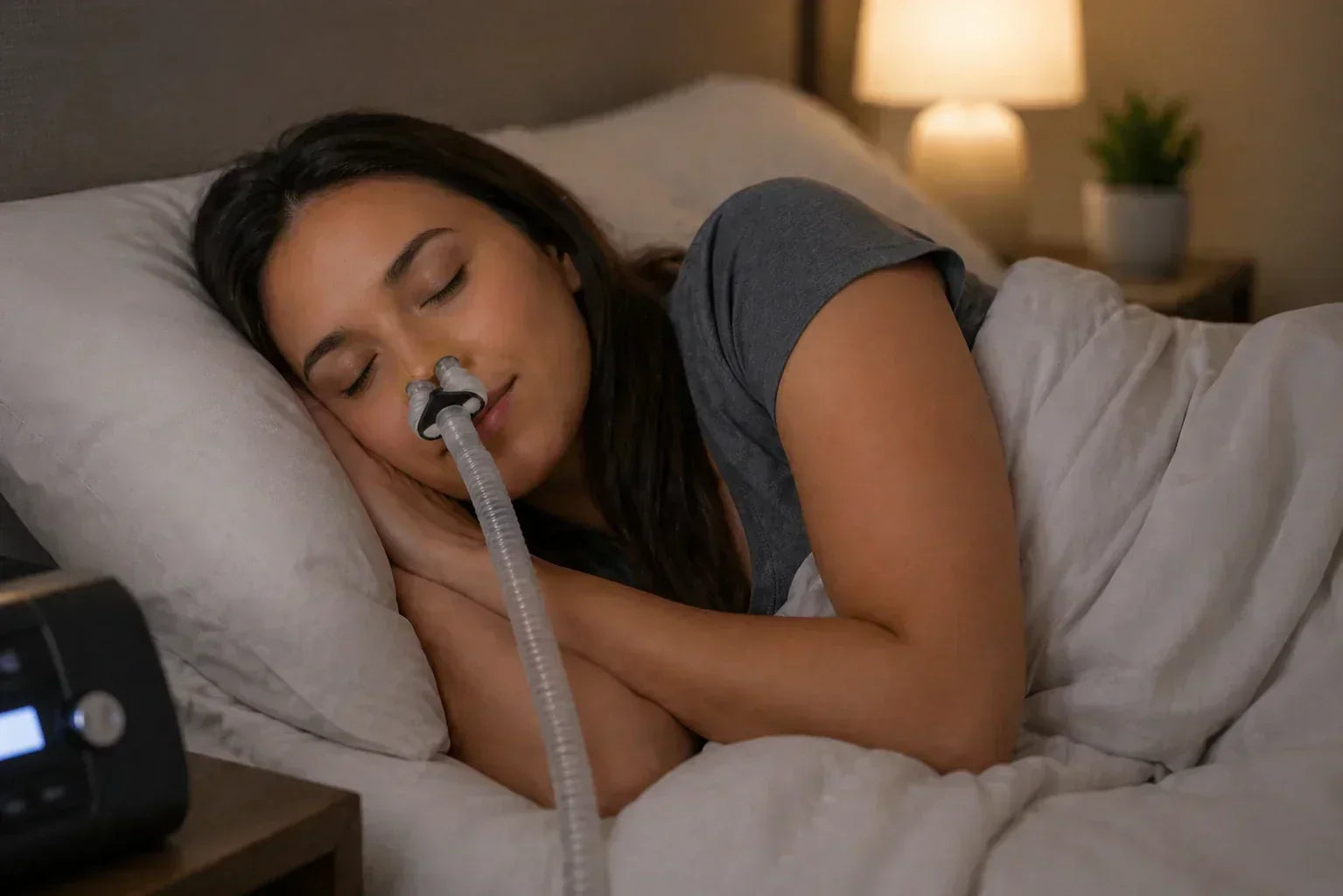
You wake up with a red mark on your cheek, dry eyes, and a CPAP report showing leaks you never felt. You did not do anything wrong. Your mask was not built for how you sleep.
The best CPAP masks for side sleepers in 2026 have minimal facial contact, no headgear pressing against the pillow, and a seal that holds through position changes all night. Options range from lightweight nasal pillow masks with top-of-head hose routing to headgear-free adhesive interfaces that remove the root cause entirely.
This guide ranks all ten honestly. The first two are headgear-free. The remaining eight are the best traditional options available. Every pick is based on design logic, not sponsored rankings.
Why Side Sleepers Struggle More With CPAP Masks
Here is the frustrating contradiction at the center of this problem. Side sleeping is actually the recommended position for people with sleep apnea, because airway obstructions occur more frequently when sleeping on the back. The position that is best for your airway is the hardest on your mask.
The problem is mechanical, not personal. When you roll onto your side, four things happen:
- Pillow leverage: The pillow pushes against the mask frame, lifting the cushion away from your face and breaking the seal.
- Headgear contact: Straps run across your temples and cheeks, exactly where the pillow presses. Every roll repositions them and changes seal tension.
- Overtightening: When leaks start, most users tighten the straps. But tighter straps distort the silicone cushion and create new leak points. According to research published in the journal SLEEP, 46 to 83% of people with obstructive sleep apnea are non-adherent to CPAP therapy, with mask discomfort and leaks being the leading causes. Side sleepers are disproportionately represented in that group.
- Repeated position changes: Most people shift positions multiple times a night. Each shift restarts the cycle.
Signs your mask is losing the battle with your sleeping position: Air blowing toward your eyes in the morning, dry mouth despite wearing the mask all night, and CPAP data showing leak events concentrated in the second half of the night.
What to Look for as a Side Sleeper
These four criteria matter most when choosing a mask as a side sleeper:
- Minimal facial contact: Less surface area against the face means fewer points the pillow can displace.
- Top-of-head hose connection: Keeps the tube out of the pillow zone and eliminates hose drag when you roll.
- Seal mechanism: Silicone cushions rely on strap tension, which changes every time you move. Adhesive seals do not rely on tension at all.
- Headgear weight: Less headgear means less material for the pillow to work against. No headgear at all is the logical endpoint of that principle.
The Top 10 CPAP Masks for Side Sleepers in 2026
1. Bleep Eclipse - Best Overall
Best for: Active side sleepers, restless sleepers and anyone who has tried multiple masks and still leaks.
The Bleep Eclipse is not a traditional mask. It is a headgear-free adhesive interface from Bleep Sleep, a North Carolina-based FDA-cleared medical device company. Each night, disposable Halo patches made from 3M medical-grade hypoallergenic adhesive are applied around the nostrils. The frame clicks on magnetically via MagSeal technology in under a second. No straps. No headgear. Nothing crosses the face.
Because there is no headgear, the pillow has nothing to work against. Because the seal is adhesive rather than tension-based, rolling from side to side has no mechanical effect on it. Independent reviews have noted that the Eclipse is over 35% smaller than other top-selling nasal pillow masks on the market, making it the lowest-profile interface available for active side sleepers.
Why it works for side sleepers:
- No headgear means nothing for the pillow to push against
- Adhesive seal holds through any position change, all night
- 35% smaller profile than leading nasal pillow masks
- MagSeal frame snaps off instantly for nighttime bathroom trips
Honest limitation: Requires a 2 to 3-minute nightly routine. Halo patches must be applied to clean, oil-free skin. Most users are comfortable with the routine within a week.
FDA-cleared. Covered by Medicare and most private insurance.
2. Bleep DreamPorts - Best for First-Time Switchers
Best for: Side sleepers making the switch for the first time, users with beards, users who want the lightest possible interface.
The Bleep DreamPorts is the original Bleep product and the first adhesive CPAP interface ever brought to market. It uses gentle adhesive pads applied to the outside of the nostrils, connecting to a patented short tube system. The seal relies entirely on adhesive rather than strap tension, which is why it holds through position changes that would displace a traditional silicone cushion. Sleep specialists who have reviewed the DreamPort note that it provides a more secure seal with fewer mask leaks while accommodating different sleep positions, which is precisely the side-sleeper problem it was designed to solve.
Why it works for side sleepers:
- Zero headgear and zero frame means zero pillow contact points
- The adhesive bond holds through every position change
- Patches attach above the beard line, compatible with facial hair
- Single-use patches mean a fresh, clean seal every night
Honest limitation: The port clip connection requires more manual dexterity than the Eclipse's magnetic snap. Some users eventually move to the Eclipse for the easier nightly connection.
FDA-cleared. Covered by Medicare and most private insurance.
3. ResMed AirFit P30i - Best Traditional Mask for Side Sleepers
Best for: Side sleepers staying in the traditional mask category, combination sleepers who change positions frequently.
The ResMed AirFit P30i uses a lightweight design, top-of-head tubing, and a close fit that makes it the strongest traditional option for side sleepers. The slender headgear rests along the sides of the head rather than pressing across the cheeks, and the top-of-head tubing connection allows position changes without hose drag. Top-of-head hose routing is the single most important improvement you can make within the traditional mask category for side sleeping, and the P30i executes it better than any competitor at this price point.
Honest limitation: Still uses headgear. Strap material contacts the pillow when sleeping on that side. Users with beards may still experience seal degradation despite the lightweight design.
4. Philips DreamWear Nasal Pillow - Best for Combination Sleepers
Best for: Restless sleepers who move between back, side, and stomach positions.
The Philips DreamWear uses a hollow-frame design where air flows through the soft frame sides and connects at the top of the head, eliminating all hose bulk directly on the face. The soft silicone headgear rests gently against the head rather than pressing against the cheeks, which reduces the material in direct pillow contact when sleeping on your side.
Honest limitation: The hollow frame channels require thorough regular cleaning. Some users find the internal air path slightly noisier at higher pressure settings.
5. ResMed AirFit N30i - Best for Users Who Dislike Nasal Pillow Inserts
Best for: Users who dislike inserts entering the nostrils, those sensitive to direct nasal airflow.
The ResMed AirFit N30i pairs top-of-head tubing with a nasal cradle cushion that rests under the nose rather than inserting into it. This avoids the direct airflow sensation that causes discomfort for many users at higher pressure settings, while still maintaining the low-profile design and top-of-head routing that make a mask workable for side sleepers.
Honest limitation: The cradle seal is more sensitive to incorrect positioning than nasal pillow inserts. Re-seating carefully after getting up at night is important.
6. ResMed AirFit F40 - Best Full-Face Mask for Mouth-Breathing Side Sleepers
Best for: Mouth breathers who need full-face coverage but want the smallest possible profile.
The ResMed AirFit F40 features an AdaptiSeal cushion that moulds to the face, operates at just 20 dBA, and seals under the nose rather than across the bridge. This reduces the contact area most affected by pillow pressure during side sleeping, making it the most practical full-face option currently available for users who cannot use a nasal-only interface.
Honest limitation: Still a full-face mask. Side sleepers who can breathe through their nose should consider a nasal-only or adhesive option first.
7. Fisher and Paykel Nova Micro - Best Adaptive Cushion
Best for: Users with narrower facial profiles, combination sleepers who need a cushion that moves with them.
The Fisher and Paykel Nova Micro features a compact, low-profile design with an adaptive silicone cushion engineered to move with the user during sleep rather than depending on the user staying still. The adaptive seal maintains contact during lateral movement, which is the specific failure point of most standard nasal masks for side sleepers.
Honest limitation: Requires correct cushion sizing. An incorrect fit negates the adaptive seal benefit entirely.
8. React Health Rio II - Best Budget Option
Best for: Budget-conscious users, combination sleepers who want adjustability at a lower price.
The React Health Rio II uses a ball-and-socket elbow design that absorbs rotational torque during position changes, and a split-back strap that allows independent adjustment on each side. The flexible elbow reduces the likelihood of the seal being pulled off-centre when you roll, which is more than most budget masks offer for side sleepers.
Recommended Product
Eclipse™ Headgear-Free CPAP Mask
No straps. No headgear. MagSeal™ adhesive technology locks in place without pressure marks — no more mask-related pressure issues. Covered by Medicare. No prescription required.
Honest limitation: Still uses headgear. Adjustability helps but does not resolve the fundamental strap-to-pillow contact issue.
9. ResMed AirFit N20 - Best for High-Pressure Side Sleepers
Best for: Side sleepers who require higher CPAP pressure settings.
The ResMed AirFit N20 uses a memory foam cushion that conforms to the face during movement rather than resisting it, making it more forgiving for active side sleepers than standard silicone cushions at higher pressure settings. For users where nasal pillow masks cannot maintain seal integrity at the required pressure level, the N20 is the most stable traditional nasal alternative.
Honest limitation: Memory foam cushions require wiping rather than washing and monthly replacement. Higher ongoing cost than silicone alternatives.
10. ResMed AirFit P10 - Best for Relatively Still Side Sleepers
Best for: Side sleepers who do not move excessively, users who want an ultra-quiet mask.
The ResMed AirFit P10 is one of the lightest nasal pillow masks on the market. Its minimal weight reduces the torque the mask exerts on its own seal when you shift position, and mesh-vent technology keeps operation exceptionally quiet for light sleepers. For users who predominantly stay on one side rather than switching repeatedly, the P10's minimalism translates directly into fewer seal disruptions.
Honest limitation: Front-mounted hose creates drag when rolling. Not ideal for highly active sleepers who switch sides repeatedly through the night.
Full Comparison at a Glance
| Rank | Product | Headgear | Hose | Seal Type | Insurance |
|---|---|---|---|---|---|
| 1 | Bleep Eclipse | None | Flexible | Adhesive + MagSeal | Yes |
| 2 | Bleep DreamPorts | None | Short tube | Adhesive | Yes |
| 3 | ResMed AirFit P30i | Minimal | Top of head | Silicone pillow | Yes |
| 4 | Philips DreamWear | Minimal | Top of head | Silicone pillow | Yes |
| 5 | ResMed AirFit N30i | Minimal | Top of head | Nasal cradle | Yes |
| 6 | ResMed AirFit F40 | Standard | Top of head | Full-face silicone | Yes |
| 7 | F&P Nova Micro | Standard | Front | Adaptive silicone | Yes |
| 8 | React Health Rio II | Adjustable | Front | Silicone pillow | Yes |
| 9 | ResMed AirFit N20 | Standard | Front | Memory foam | Yes |
| 10 | ResMed AirFit P10 | Minimal | Front | Silicone pillow | Yes |
The Real Solution Is Removing Headgear Entirely
Every step from rank 10 to rank 3 in the table above represents some degree of headgear minimisation. Lighter straps, better hose routing, smaller frames. Ranks 1 and 2 take that logic all the way to its conclusion: no headgear at all.
A comprehensive 20-year review of CPAP adherence data published in the journal Sleep and Breathing found that non-adherence rates have remained stubbornly persistent at 30 to 40%, with no meaningful improvement despite advances in quieter pumps, softer masks, and improved portability. The mask interface remains the primary barrier. The Eclipse and DreamPorts address it at the design level, not the adjustment level.
Both are FDA-cleared, covered by Medicare and most private insurance, and require no straps to fit, adjust, or maintain overnight. If you have been waking up at 3 am to readjust headgear for longer than you can remember, exploring the Eclipse and DreamPorts at Bleep Sleep is the next logical step.
Frequently Asked Questions
Why does my CPAP mask leak when I sleep on my side?
Side sleeping presses the mask frame into the pillow, which lifts the silicone cushion away from your face and breaks the seal. Headgear straps run across the temples and cheeks, both in direct pillow contact. This is a structural problem with headgear-based mask design, not a fitting error.
Are headgear-free CPAP masks as effective as traditional masks?
Yes. FDA-cleared adhesive interfaces like the Bleep Eclipse and DreamPorts deliver the same therapy pressure as traditional masks. The adhesive seal is more mechanically stable for side sleepers because it does not rely on strap tension, which shifts every time you move.
Does insurance cover Bleep Sleep products?
Both the Eclipse and DreamPorts are covered by Medicare and most private insurance plans. Bleep also accepts VA benefits. You can check your specific coverage on the Bleep Sleep insurance page.
Final Thoughts
Side sleepers do not have a CPAP problem. They have a mask design problem. Every traditional mask on this list is a genuine option, and some are very good within their category. But they are all working around headgear rather than removing it.
The reason the Bleep Eclipse and DreamPorts sit at the top of this list is not that they are the most expensive or the most well-known. It is because they are the only two interfaces that address the side-sleeper leak problem at its mechanical root. No headgear means no seal disruption when you roll over. That logic does not require a clinical trial to validate. It requires understanding why traditional masks fail in the first place.
If you are on mask number two or three and still waking up to leaks, the pattern is the equipment, not you. Visit Bleep Sleep to explore both options and check your insurance coverage before your next purchase.
Frequently Asked Questions
What type of CPAP mask is best for side sleepers?
Nasal pillow and minimal-contact masks work best for side sleepers because they have a low profile that does not dig into the pillow or shift out of position when turning during sleep.
Do side sleepers struggle more with CPAP mask leaks?
Yes. Traditional full-face and nasal masks can gap and leak when pressed against a pillow, making masks with small footprints or adhesive seals a better option for side sleeping positions.
Can I use a CPAP mask without headgear as a side sleeper?
Yes. Headgear-free designs that attach at the nostrils have no straps to shift or catch on pillows, making them particularly well suited to side and stomach sleeping positions.
How do I stop my CPAP mask from moving when I sleep on my side?
Choose a low-profile or adhesive mask, use a CPAP-friendly pillow with cutouts, and ensure your mask is fitted correctly before lying down to reduce movement and leaks overnight.
Does BleepSleep make a mask suited for side sleepers?
Yes. The BleepSleep DreamPort and Eclipse with Halos adhesive interfaces have no protruding headgear or frame, making them an ideal solution for side sleepers who need a stable, low-profile seal.


