

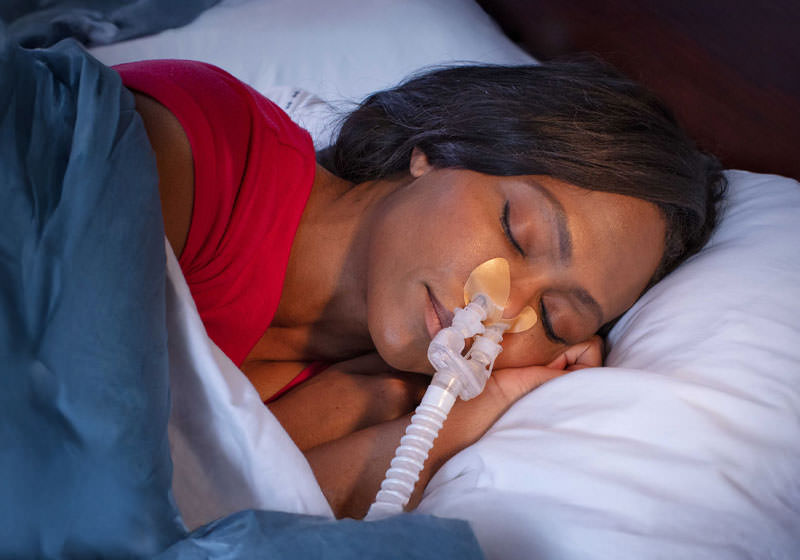
For many veterans and trauma survivors, the prescription that should help them sleep better becomes another source of distress. A traditional CPAP mask, with its face-covering cushion, headgear straps, and pressurized airflow, can activate the exact same physiological responses that PTSD therapy works to reduce: the sense of confinement, loss of control, and restricted breathing.
This isn't an uncommon situation. Research shows that veterans with PTSD have significantly lower CPAP adherence rates than those without PTSD, and clinical literature has documented CPAP mask intolerance as a recognized challenge in this population. The good news is that the specific elements of traditional masks that trigger trauma-related responses can be removed entirely with minimal-contact, strap-free interfaces.
This guide explains why CPAP masks are particularly challenging for people with PTSD, which mask properties are most problematic, and what alternatives exist that can make treatment genuinely achievable.
How Often Do PTSD and Sleep Apnea Occur Together?
The overlap between PTSD and obstructive sleep apnea is substantial. According to research reviewed by SleepApnea.org, veterans with combat-related PTSD are significantly more likely to develop obstructive sleep apnea than veterans without PTSD, and studies have found the co-occurrence rate to be very high in veteran populations who have seen active combat.
The relationship runs in both directions. PTSD contributes to sleep apnea through several mechanisms: hypervigilance keeps the nervous system activated during sleep, disrupting normal breathing patterns; chronic muscle tension affects the throat and airway; and fragmented sleep from nightmares reduces time spent in the deeper sleep stages where airway stability is maintained.
Sleep apnea, in turn, worsens PTSD symptoms. Each apnea event during the night triggers a micro-arousal and a cortisol release. Over time, hundreds of nightly stress activations elevate baseline hypervigilance and emotional reactivity during waking hours. Treating the sleep apnea effectively is a meaningful part of managing PTSD, not a separate concern. Research has found that consistent CPAP use can reduce PTSD-related nightmares by a significant margin in some patients.
The challenge is getting to consistent use when the mask itself is a barrier. For more context on why treating sleep apnea matters for broader health, our post on how sleep apnea impacts heart health covers what untreated apnea does beyond sleep quality alone.
Why Traditional CPAP Masks Trigger Trauma Responses
PTSD-related CPAP mask intolerance is distinct from the general CPAP anxiety that affects many new users. General CPAP anxiety is primarily driven by the unfamiliar sensation of pressurized airflow and the claustrophobic feeling of a face covering. PTSD-related intolerance can involve additional layers: the mask may activate trauma memories specific to the individual's experience, and the physiological response can be immediate and intense even before the machine is turned on.
Several properties of traditional CPAP masks are particularly problematic for trauma survivors.
Face covering
A mask covering the nose or mouth and nose replicates the experience of having the face covered or obscured. For trauma survivors whose experiences involve restriction, suffocation, or loss of airway control, this contact can be a direct sensory trigger. The brain can generate a threat response based on the physical sensation alone, before any rational evaluation of safety occurs.
Restraint sensation from headgear
Straps that loop around the head, under the chin, and across the face create a physical sensation of being held or restrained. For many trauma survivors, the feeling of restraint is among the most powerful triggers in any context. Even when the straps are loose enough to be objectively non-restraining, the proprioceptive sensation of straps against the head during sleep can activate the same physiological alarm.
Loss of control during sleep onset
Sleep onset requires a degree of letting go. For people with PTSD, maintaining alertness and control is a protective mechanism. The combination of being in a vulnerable state (trying to fall asleep) while physically constrained by a mask and headgear can make the nervous system resist sleep onset entirely. Hyperarousal increases rather than decreases, which means the therapy being administered by the machine isn't reaching someone who can actually benefit from it.
Pressurized airflow sensation
For some trauma survivors, particularly those whose trauma involved breathing restriction, the sensation of pressurized air entering the airway can be experienced as respiratory distress rather than respiratory support. The false suffocation alarm responds to the incoming pressure signal as a threat even though the actual effect is the opposite.
What to Look for in a CPAP Interface When PTSD Is a Factor
The goal is to find an interface that delivers effective CPAP therapy while minimizing or eliminating the specific sensory elements that activate trauma responses. This means evaluating each of the following properties.
No headgear or straps
Eliminating headgear eliminates the restraint sensation entirely. Headgear-free interfaces hold in place through adhesive or magnetic closure rather than mechanical strapping. There is nothing crossing the head, nothing clipping behind the ears, and no tension holding anything against the face. For trauma survivors whose primary trigger is the restraint sensation, removing the headgear often removes the most significant barrier to tolerating CPAP.
Minimal face contact
The less surface area the interface covers, the fewer trauma-related sensory signals it generates. Full face masks cover the most area and are the most likely to activate face-covering trauma triggers. Nasal-only interfaces cover substantially less. Nostril-only adhesive or magnetic interfaces cover the least of any option available, contacting only the small area at and immediately around the nostrils.
Freedom of movement
An interface that stays secure during natural movement during sleep allows the user to shift positions without the sense that the mask is constraining or controlling their movement. Lightweight, low-profile interfaces that move with the body rather than pulling against it reduce the sense of physical constraint throughout the night.
Easy removal at any moment
For trauma survivors, knowing that the interface can be removed immediately without fumbling with buckles or clips is psychologically important. An interface that detaches instantly, without requiring hands to find and release a strap system, supports the sense of control that PTSD management depends on.
How Minimal-Contact Interfaces Address PTSD-Specific Triggers
Bleep Sleep's Eclipse CPAP Solution is designed specifically to eliminate the elements of traditional masks that most commonly drive non-compliance. It uses MagSeal magnetic technology to create a seal at the nostrils with no straps, no headgear, no face covering, and no frame resting against the face. FDA cleared (K172335), it sits compactly at the nostrils and connects to standard CPAP tubing.
For trauma survivors, the practical difference is significant. There is no restraint sensation because there are nothing to restrain. Your face is completely uncovered. Your field of vision is entirely clear. The interface can be detached in a single motion at any point during the night. You can move freely in any position without the interface pulling or resisting.
Users with PTSD who have tried multiple traditional masks often describe the first night with a headgear-free minimal interface as qualitatively different from any previous CPAP experience. The absence of the restraint and face-covering triggers doesn't guarantee that adaptation will be instant, but it removes the primary obstacles that made adaptation impossible with traditional designs.
VA Coverage for CPAP Supplies
Veterans with service-connected sleep apnea or sleep apnea documented as secondary to a service-connected condition such as PTSD are eligible for VA coverage of CPAP equipment and supplies. This includes the CPAP machine, masks, tubing, and replacement interfaces.
In 2026, the VA's approach to sleep apnea ratings continues to require documentation of CPAP use for the 50% disability rating. Veterans who cannot use traditional CPAP masks due to a service-connected condition such as PTSD can document this intolerance with a medical opinion, which may support continued eligibility for higher ratings while alternative interface options are explored.
Working with your VA provider to document both the sleep apnea diagnosis and any PTSD-related mask intolerance creates the clinical record needed to support your benefits claim and to justify a referral to alternative interface options covered under DME benefits.
For information on how VA and insurance coverage applies to Bleep Sleep products, see the insurance, DME, and VA coverage page for details on eligibility and ordering options.
Working With Your VA or Mental Health Provider
CPAP mask intolerance related to PTSD is a recognized clinical challenge. You don't need to work through it alone, and you shouldn't have to justify the difficulty to your care team.
Ask your VA sleep medicine provider specifically about CPAP interface alternatives. Not all providers are familiar with headgear-free options, and you may need to request a referral or specifically ask whether minimal-contact interfaces are covered under your DME benefits. Bringing documentation of mask intolerance, including notes about which specific sensations trigger your response, helps your provider understand what interface properties need to change.
If your primary barrier to CPAP use is trauma-related rather than physical comfort, ask your VA mental health team whether CPAP-specific desensitization support is available. Some VA medical centers have sleep medicine and mental health providers who collaborate specifically on CPAP adherence for patients with comorbid PTSD and sleep apnea.
Some veterans find it helpful to review general strategies for building CPAP tolerance alongside the interface change. Our post on how to make CPAP easier to use covers practical approaches that complement whatever clinical support your VA team provides.
Frequently Asked Questions
Can CPAP therapy actually help with PTSD symptoms?
Research suggests it can, particularly for sleep-related PTSD symptoms. Consistent CPAP use reduces the number of apnea events per night, which in turn reduces the cortisol and adrenaline releases that compound hypervigilance. Some studies have found meaningful reductions in PTSD-related nightmare frequency with effective CPAP treatment. Treating the sleep apnea doesn't treat the underlying trauma, but it removes a physiological stressor that worsens PTSD symptoms.
Will the VA cover a headgear-free CPAP interface?
VA DME coverage for CPAP supplies generally includes mask interfaces. Whether a specific product is covered depends on your VA provider's prescription and your regional VA's formulary. Ask your VA sleep medicine provider to document the medical necessity of an alternative interface due to PTSD-related mask intolerance. This documentation supports coverage decisions. The insurance and VA coverage page has specific information on how to navigate this for Bleep Sleep products.
What if I've tried CPAP before and couldn't tolerate it at all?
A previous failed CPAP attempt with a traditional mask doesn't mean therapy isn't possible for you. Many veterans who couldn't tolerate any conventional mask find that the specific triggers are absent with headgear-free minimal interfaces. It's worth attempting again with a fundamentally different interface type before accepting that CPAP therapy isn't viable.
Should I tell my CPAP provider about my PTSD?
Yes. Your CPAP equipment provider can help you select an interface specifically suited to your situation if they understand your triggers. Being clear that straps, face coverage, or a sense of restraint are primary barriers helps them recommend appropriate alternatives rather than defaulting to standard mask options.
Is there a difference between PTSD-related CPAP intolerance and ordinary claustrophobia?
There can be overlap, but they're not the same. General CPAP claustrophobia is typically about the sensation of confinement and unfamiliar airflow pressure. PTSD-related intolerance may involve those same elements plus specific trauma memory activation, a faster and more intense physiological response, and triggers that are specific to the individual's history. Both benefit from minimal-contact interfaces, but PTSD-related intolerance may also benefit from collaboration with a mental health provider familiar with trauma-informed approaches to medical device use.
You Deserve a Treatment That Works
Sleep apnea is a serious condition, and the combination of untreated apnea and PTSD creates a compounding burden on sleep quality and daily functioning. The answer isn't to accept that CPAP therapy isn't possible for you. It's to find an interface that removes the specific sensory elements driving intolerance.
A headgear-free, minimal-contact CPAP interface eliminates the face-covering and restraint sensations that make traditional masks intolerable for many trauma survivors. Combined with support from your VA care team, it gives therapy a genuine opportunity to work.
To see how VA and insurance coverage can support access to alternative CPAP interfaces, visit the insurance, DME, and VA coverage page for current eligibility information and ordering options.


